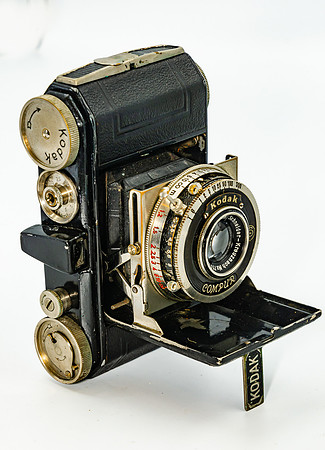
The Kodak Retina 117 (1934) marks one of the most important turning points in 20th‑century camera history: it was the first Retina model and the first Kodak camera to use the new 35 mm daylight‑loading cartridge—what we now call 135 film. This single innovation reshaped amateur photography worldwide.
Below is a structured, collector‑grade history tailored to your interest in early engineering and design evolution.
📷 Kodak Retina 117 (1934): History, Making & Significance
🛠️ 1. Origins and Manufacturing Context
• Introduced: December 1934
• Produced by: Kodak AG – Dr. Nagel Werk, Stuttgart, Germany
• Designer: Dr. August Nagel, formerly of Contessa‑Nettel and Zeiss Ikon
• Background:
• Kodak purchased Nagel Camerawerk in 1931, retaining Nagel as chief designer.
• Nagel had already designed advanced miniature cameras (Vollenda, Pupille, Duo‑620), giving Kodak instant access to German precision engineering.
The Retina 117 was the first product of this new Kodak–Nagel partnership and set the tone for the entire Retina line.
🧩 2. Construction & Technical Features
A. Body & Mechanism
• Compact folding 35 mm camera with self‑erecting bellows.
• Nickel‑plated brightwork (chrome came later with Retina Type 126).
• Precision‑machined metal chassis typical of Nagel’s engineering style.
B. Lens & Shutter Options
• Schneider Xenar 5 cm f/3.5 in Compur or Compur‑Rapid shutter
• Kodak Anastigmat 5 cm f/3.5 in Compur shutter
These lenses gave the Retina optical performance competitive with Leica and Contax of the same era.
C. Film System
• Designed around Kodak’s brand‑new 35 mm daylight‑loading cartridge (later standardized as 135 film).
• Eliminated the need for darkroom loading—previous 35 mm systems required hand‑loaded cassettes.
• This innovation made 35 mm photography accessible to the general public.
🌍 3. Historical Significance
⭐ A. The First Retina Camera
The Retina 117 launched a line that would run until 1969, including folding models, rangefinders, and SLRs. It established the Retina as Kodak’s prestige German‑built camera family.
⭐ B. Birth of the 135 Film Standard
The Retina 117 was introduced simultaneously with Kodak’s new daylight‑loading cartridge.
This cartridge:
• Became the global standard for 35 mm still photography
• Was compatible with Leica and Contax
• Remains the basis of modern 35 mm film today
This is arguably the Retina 117’s greatest historical impact.
⭐ C. Democratization of High‑Quality 35 mm Photography
The Retina 117 was priced lower than Leica and Contax, yet offered:
• German build quality
• High‑grade lenses
• Compact folding design
This combination brought 35 mm photography to a much wider audience.
⭐ D. A Milestone in Kodak’s German Engineering Era
The Retina 117 represents the moment Kodak fully embraced precision German manufacturing, giving the company a foothold in the high‑quality miniature camera market.
🏛️ 4. Collector Importance Today
✔️ First of the Retina line — foundational model
✔️ Short production window (1934–35) — relatively scarce
✔️ Nickel‑plated early finish — distinctive to the 117
✔️ Lens variants — Xenar vs Kodak Anastigmat affect value
✔️ Historical milestone — first camera built for the 135 cartridge
For a collector with your interest in early 20th‑century engineering, the Retina 117 is a keystone piece: it represents the convergence of Nagel’s precision design and Kodak’s global mass‑market strategy.
📌 Summary
The Kodak Retina 117 (1934) is historically significant as the first Retina, the first Kodak 35 mm camera, and the launch platform for the 135 film cartridge that defined 20th‑century photography. Its combination of German engineering, compact folding design, and accessible pricing made it one of the most influential miniature cameras ever produced.