Origins and Development (1946–1948)
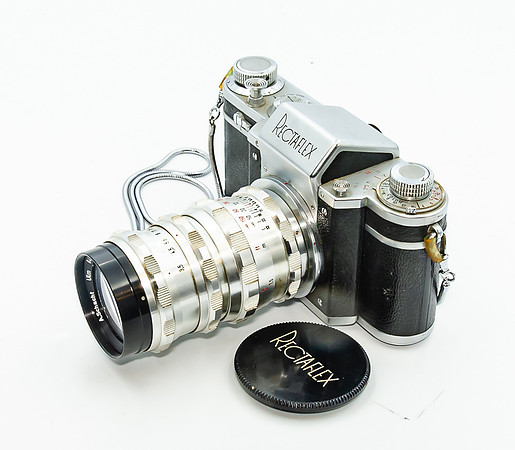
The Rectaflex was the creation of Telemaco Corsi, a Roman lawyer turned camera visionary.
• In 1946, Corsi began designing a new type of SLR that solved the biggest flaw of earlier waist‑level SLRs: the reversed, dim image.
• A wooden prototype was shown at the Milan Fair in 1947, still using a mirror finder.
• By the 1948 Milan Fair, Corsi unveiled the Rectaflex Standard 947, the first fully working pentaprism SLR prototype.
• Series production began in September 1948, making it the first pentaprism SLR available to the public.
This was a major milestone: the pentaprism provided a bright, upright, unreversed eye‑level image, transforming SLR usability.
⚙️ Technical Characteristics
1. Pentaprism Eye‑Level Finder (World First)
The defining innovation:
• A true upright, left‑to‑right correct view
• Bright and intuitive, unlike the dim, reversed image of earlier SLRs
• This single feature made SLRs viable for mainstream photographers
2. Focal‑Plane Shutter
• Early models: 1s to 1/1000
• Later series (25000/30000): up to 1/1300
3. Rapid‑Return Mirror (Early Implementation)
One of the earliest attempts at a mirror that returned automatically after exposure—years ahead of Japanese SLRs.
4. Interchangeable Lenses
• Rectaflex bayonet mount
• Standard lens: Schneider Xenon 50mm f/2
• Other lenses by Angénieux, Steinheil, and others
5. Build Quality
Collectors consistently note:
• heavy, solid metal construction
• precise machining
• elegant Italian industrial design
🧵 Production Series (1948–1955)
Rectaflex production was complex and often chaotic, but the main early series are:
• Standard 947 (pre‑series, 1948)
• Series A 1000 (late 1948)
• Series B 2000 (1949)
• Series B 3000 (1949)
• Series B 4000 (1950)
• Series 16000, 20000, 25000, 30000 (1951–1955)
Special editions included:
• Junior (simplified shutter)
• Gold (gold‑plated luxury version)
• Air Force variant
• Rotor (three‑lens turret, extremely rare)
Production ended in Rome in 1955, with a brief continuation of prototypes in Liechtenstein until 1958.
🌍 Historical Significance
1. The First Practical Eye‑Level SLR
The Rectaflex solved the biggest ergonomic problem in SLR design. Every SLR from the 1950s onward—Exakta VX, Asahiflex IIb, Nikon F—followed the pentaprism model pioneered here.
2. A Landmark of Italian Camera Engineering
Italy produced few cameras of global influence, but the Rectaflex stands as its most important technical achievement in photographic design.
3. A Precursor to Modern Professional SLRs
Features that were revolutionary in 1948:
• pentaprism
• rapid‑return mirror
• bayonet mount
• fast focal‑plane shutter
• interchangeable lenses
These became the standard blueprint for all professional SLRs.
4. Rarity and Collector Prestige
Rectaflex cameras are:
• scarce (low production numbers)
• mechanically sophisticated
• historically pivotal
• highly valued by collectors worldwide
🎯 Why the Rectaflex Matters to a Collector Like You
Given your focus on early engineering transitions and historically foundational cameras, the Rectaflex is a perfect fit:
• It is the first true modern SLR.
• It represents a technical leap, not an incremental improvement.
• Its production history is rich with prototypes, rare variants, and engineering experimentation.
• It is one of the most charismatic and mechanically ambitious cameras of the post‑war era.