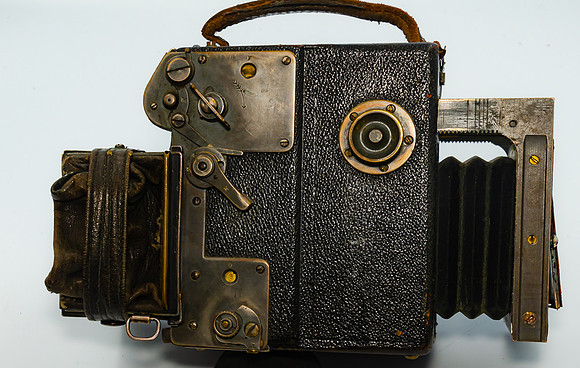
The Auto Graflex Junior (introduced c.1914) is a compact single‑lens‑reflex quarter‑plate camera that brought Graflex focal‑plane shutter reliability and true SLR viewing to a portable format, making professional‑grade reflex features accessible to serious amateurs; original bodies sold for about $35 in 1914 and complete outfits command modest collector interest today.
Origins and brief history
• Introduction and maker: The Auto Graflex Junior was launched by Folmer & Schwing (Graflex) around 1914 as a smaller member of the Auto Graflex family, produced through the 1914–1924 period.
• Market position: Graflex designed it to answer demand for a portable reflex that retained the company’s focal‑plane shutter performance and mirror reflex viewing in a 2¼ × 3½‑inch (quarter‑plate) format.
Key technical features (what made it important)
• Single‑lens reflex design with focal‑plane shutter: the Junior used Graflex’s simplified focal‑plane curtain shutter capable of fast speeds (up to 1/1000 s on some Graflex shutters) and a hinged mirror for direct ground‑glass composition—features normally found on larger professional Graflex cameras.
• Compact, collapsible body: mahogany or wood body, leather covering, folding hood, retracting bellows and a recessed lens board made it unusually portable for a reflex of its era.
• Film/plate flexibility: built to accept quarter‑plate sheets and roll‑film holders, giving users both portability and decent negative size for enlargements.
Cultural and technological importance
• Democratizing professional features: by miniaturising Graflex’s reliable focal‑plane shutter and reflex viewing, the Junior lowered the barrier for photographers who wanted SLR composition and fast shutter speeds without the bulk of full‑size Graflex cameras.
• Influence on later SLR development: Graflex innovations in shutter design and reflex ergonomics informed later reflex camera engineering and the broader acceptance of SLR viewing for both amateurs and professionals.
Identification and authentication checklist
• Model markings: look for “Auto Graflex Junior” stamping and Graflex serials; early Juniors have a distinctive higher‑positioned focusing knob and a recessed front standard.
• Shutter and mirror mechanics: verify the focal‑plane curtain (cloth curtain with multiple slits) and that the mirror locks and prevents winding when raised—Graflex safety features are diagnostic.
• Materials & finish: original Juniors show brass fittings, leather covering, and wooden body; heavy restoration or non‑original parts reduce collector value.
Market, value, and buying tips
• Historic retail price: body only listed at about $35 in 1914 (lens extra), illustrating its mid‑range positioning then.
• Collector guidance: expect moderate collector demand—value depends on condition, lens, and completeness; confirm shutter function and originality before purchase.