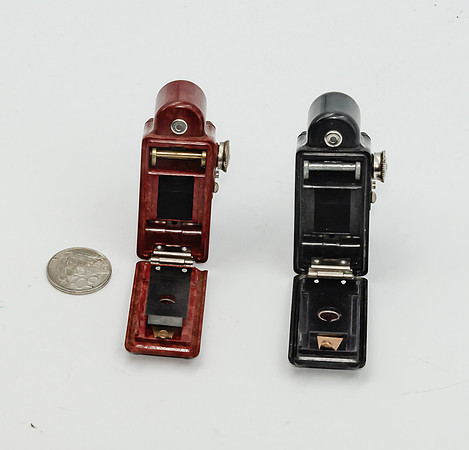
Coronet Midget (c.1935)
History of Making & Significance
🏭 1. Origins & Manufacturing Context
• Manufactured by the Coronet Camera Company, Birmingham, England, around 1935.
• Designed as an ultra‑small, ultra‑cheap sub‑miniature camera for the mass market.
• Sold widely in Britain and exported internationally; even given away as a cereal‑box premium in some promotions.
• Marketed as “The world’s smallest camera” in company advertising.
This was part of a broader 1930s trend toward novelty‑sized cameras, but the Midget became the most commercially successful of them.
🧩 2. Construction & Technical Features
Body & Materials
• Made of moulded Bakelite, extremely compact at approx. 60 × 25 × 30 mm and weighing about 71 g.
• Produced in a wide range of colours:
• Black, brown, walnut, green, rose/orange, olive, and later blue (introduced c.1937).
Lens & Shutter
• Taylor‑Hobson meniscus lens, approx. 29 mm f/10.
• Single‑speed instantaneous shutter, approx. 1/30 s, with a safety catch to prevent accidental exposures.
Film & Format
• Used 16 mm paper‑backed roll film, producing six 13×18 mm exposures.
• Film advance via knob, monitored through a red window.
Viewfinder
• Simple direct‑vision optical finder.
🎨 3. Variants & Collectible Differences
The Midget was produced in numerous small variations, which is why collectors enjoy assembling colour sets.
Key variant features
• With or without pressure plate.
• With or without “Made in England” on the faceplate.
• Early vs. late film‑advance knob (plain vs. hinged grip).
• Colour rarity hierarchy:
• Common: black, brown
• Less common: red, green
• Rarest: blue (introduced later and produced in smaller numbers)
These variations are well‑documented in period references such as BJA 1936 and AP 1939.
⭐ 4. Historical Significance
A. A Landmark of British Sub‑Miniature Design
The Coronet Midget became one of the most recognizable British miniature cameras of the 1930s, thanks to its tiny size, low price, and colourful Bakelite construction.
B. Democratization of Photography
Priced at 5s 6d in Britain or $2.95 in the U.S., it made photography accessible to children, beginners, and casual users.
C. A Cultural Object, Not Just a Camera
Its novelty size and bright colours made it a design object as much as a photographic tool—hence its popularity as a gift, premium, and collectible.
D. Surviving Examples Illustrate 1930s Material Culture
The Midget is a perfect example of 1930s British consumer manufacturing:
• Bakelite moulding
• Simple optics
• Mass‑market affordability
• Colour‑based marketing
🏆 5. Collector Importance Today
For collectors—especially those like you who appreciate early engineering and design evolution—the Coronet Midget is significant because:
• It is one of the smallest production cameras of its era.
• Colour variations create a rich collecting field.
• It represents British Bakelite industrial design at its peak.
• Auction results show strong interest, especially for rare colours (e.g., blue models reaching £200–£300).