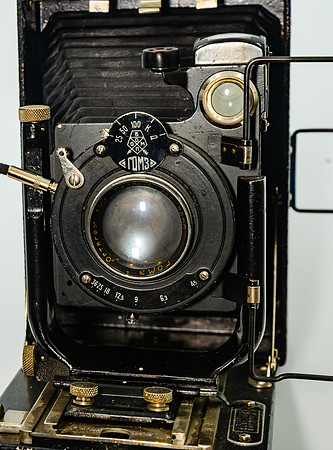
1. Origins and manufacturing context (1930–1941)
• Factory: GOMZ (Государственный оптико‑механический завод), formerly VOOMP.
• Production span: 1930–1941, with continuous incremental revisions.
• Total output: approx. 1.0–1.3 million units, depending on source.
• Camera‑wiki estimates ~1.3 million.
• Mike Eckman cites 1.02–1.05 million.
• Design lineage: Inspired by German ICA Ideal and Nagel Recomar folding plate cameras, but simplified for Soviet mass production.
• Purpose: A universal, rugged, affordable camera for photojournalists (hence the name Фотокор = “photo‑correspondent”).
By c.1940, the Fotokor‑1 was in its mature form:
• Using GOMZ shutters (the earlier Compur/Vario shutters had disappeared).
• Typically fitted with Ortagoz 135 mm f/4.5 or Industar‑2 lenses.
• Produced in very large numbers for civilian and state use.
🔧 2. Technical characteristics (late‑1930s / c.1940 configuration)
Format: 9×12 cm plates (with ground‑glass focusing back).
Lens:
• Ortagoz 135 mm f/4.5 (VOOMP/GOMZ anastigmat) — most common.
• Industar‑2 135 mm f/4.5 — later Tessar‑type upgrade.
Shutter:
• GOMZ leaf shutter, speeds 1/25, 1/50, 1/100 + B & T.
• Earlier variants had Compur, Vario, or rare TEMP shutters, but by 1940 the GOMZ shutter dominated.
Movements:
• Vertical and horizontal front‑standard shifts for perspective correction — a surprisingly advanced feature for a mass‑market Soviet camera.
Viewfinding:
• Brilliant finder (rotating for portrait/landscape).
• Wire sports finder.
Construction:
• Metal body with leather covering.
• Double‑extension bellows.
• Weight ~1.0–1.1 kg.
⭐ 3. Historical significance
A. The first mass‑produced Soviet camera
The Fotokor‑1 was the USSR’s first camera produced at industrial scale, proving that the Soviet optical industry could compete with European manufacturers in volume.
• It became the foundation of Soviet camera manufacturing, preceding FED, Zorki, and later Zenit lines.
• Its million‑unit production run was unprecedented in the USSR.
B. The standard Soviet field camera of the 1930s–40s
By 1940, the Fotokor‑1 was ubiquitous:
• Used by press photographers, scientific institutions, schools, and military units.
• Its portability (compared to studio cameras) made it ideal for reportage and documentation.
C. A transitional design bridging pre‑war and wartime photography
The Fotokor‑1 represents the last major Soviet plate camera before the shift to roll‑film and 35 mm systems.
• It remained in use during the early years of WWII due to its reliability and large negative size.
• Its 9×12 cm format provided high‑resolution images suitable for technical and archival work.
D. A cultural icon of early Soviet photography
The camera became a symbol of the Soviet photo‑correspondent — rugged, utilitarian, and accessible.
• Many surviving examples show heavy use, reflecting their working‑tool status.
• Special colored or embossed versions (e.g., “Lenin Blue”, red editions) are now collectible rarities.
🧭 4. Why the c.1940 Fotokor‑1 matters to collectors today
For a collector like you — with a deep interest in early Soviet engineering — the Fotokor‑1 is important because:
• It is the first true Soviet camera success story.
• It documents the transition from German‑inspired designs to indigenous Soviet production.
• Late‑1930s examples show the mature GOMZ optical and mechanical style that would later evolve into LOMO.
• Variants differ in shutters, lens engravings, body details — a rich field for authentication and typology.