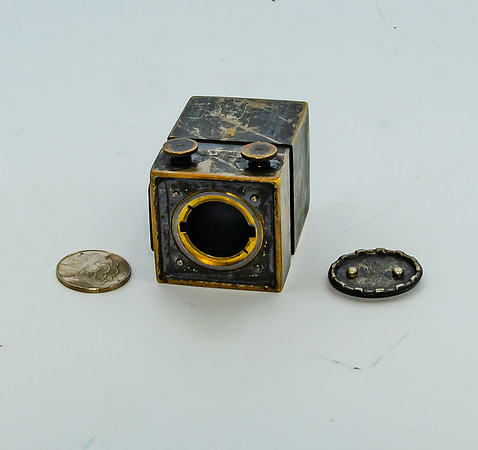
The camera was created by Alfred C. Kemper of Chicago in the early 1890s, based on a patent by William V. Esmond in 1892. It was introduced in 1892–1893 and marketed as both a camera and a graphoscop influencing later compact camera design.
📷 Overview
- Name: Kemper Kombi (sometimes referred to as “Combi”)
- Era: Early 1890s (patented 1892; introduced 1892–1893)
- Inventor: William V. Esmond
- Manufacturer: Alfred C. Kemper Co., Chicago
- Format: 1⅛ × 1⅛ inch square exposures (25 per roll)
- Construction: All‑brass body with oxidized silver finish
- Notable Feature: Combined camera + graphoscope (viewer) in one instrument
- Film: Special roll film produced by Kodak specifically for this camera
🕰 Historical Significance
The Kombi camera holds several “firsts” in photographic history:Key Innovations
- First miniature roll‑film camera
- First metal‑bodied roll‑film camera
- First camera to use Kodak film made for a non‑Kodak product
- First camera with an interchangeable roll‑film magazine back
- First camera combining taking and viewing (graphoscope) functions
These innovations made it a technological leap forward at a time when most cameras were still bulky, wooden, and used plate photography. 🔍 Design & Operation
- Size: Extremely compact — approx. 1¾ × 1¾ × 2⅛ inches
- Body: Brass with decorative engraving
- Lens: Fixed-focus with interchangeable aperture plates
- Film Handling:
-
- Roll‑film magazine could be removed and sent to the factory for processing
- Transparency film produced positive images for viewing in the built‑in graphoscope
- Shutter: Cocked via a small lever on the top
Despite its tiny size, the camera was not especially easy to operate, and contemporary users often found it more complex than Kodak’s own simple box cameras. 💰 Collectability
Today, original Kombi cameras are
relatively rare, especially in good condition with accessories.
- One example sold at Christie’s in 2001 for over $400.
- Their value depends on condition, finish, completeness (box, graphoscope parts), and provenance.
🧭 Summary
If you’re researching or collecting early miniature cameras, the
Kemper Kombi is one of the most historically important models from the 1890s. It represents a turning point in portable photography and early roll‑film technology, predating many Kodak compact cameras and influencing the evolution of consumer photography.