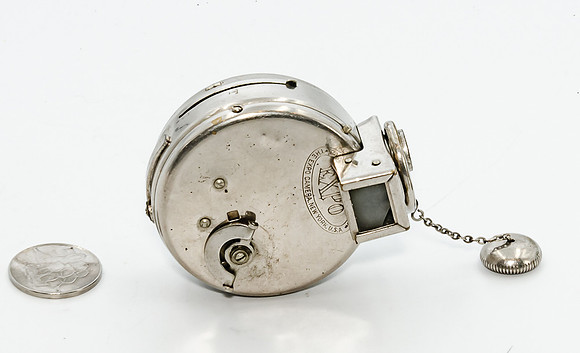
The Expo (often called the “Expo Watch” or Ticka in Britain) is a pocket‑watch–style sub‑miniature camera patented in 1904 and produced from about 1905; it popularised a daylight‑loadable drop‑in film cassette and tiny 16×22 mm images, making covert, novelty and novelty‑portable photography widely available to the public. In Auckland today, expect Expo examples to appear mainly in specialist collections, online auctions, and camera‑collecting shows rather than general museums.
Origins and brief history
• Inventor: Swedish engineer Magnus Niéll; US patent granted 6 September 1904 (assigned in part to Thomas Wallace).
• Production period: First marketed c.1905, with variants and licensed manufacture (as the Ticka) in Britain; production and brand use continued in various forms into the 1920s–1930s.
Design and technical features
• Form factor: pocket‑watch style body about 2.1–2.25 in (≈54–57 mm) diameter, designed to be disguised as a watch for discreet use.
• Film format: Drop‑in cassette with paper‑backed roll film producing 25 exposures of 16×22 mm (≈5/8″×7/8″) per cassette—one of the camera’s most important practical innovations.
• Shutter and lens: Simple fixed‑focus lens (typical focal lengths ~25–30 mm), a single‑speed sliding or spring shutter (~1/25 s) plus a B (time) setting; early models required the lens cap to prevent double exposures when cocking.
Cultural and technological importance
• Daylight‑loadable cassette: The Expo’s daylight‑reloadable cassette made sub‑miniature photography practical for casual users and novelty markets, reducing the technical barrier to reloading film.
• Stealth and novelty use: Its watch disguise and small negatives made it popular for “spy” or detective” novelty photography and for users wanting a highly portable camera. This influenced later sub‑miniature and novelty camera designs.
Where collectors and researchers can look
• Common places to find examples: specialist camera dealers, online auction sites, and camera‑collecting forums; the Expo/Ticka is collectible but relatively common compared with rarer early plate cameras.
• Documentation: user manuals, patent US769319, and dedicated collector pages (Submin, Camera‑Wiki, Historic Camera) provide technical details and variant lists.
Collector considerations and risks
• Condition matters: nickel plating wear, missing lens cap, and non‑working shutter greatly reduce value.
• Film and processing: Original cassette film is obsolete; modern collectors either scan existing negatives or adapt modern sub‑miniature film/processing—expect extra cost and specialist labs.