1. Historical Context (1955–1958)
KMZ in the mid‑1950s
By 1955, Красногорский механический завод (KMZ) was:
• recovering from post‑war production pressures,
• modernizing its optical/mechanical lines,
• preparing to shift from Leica‑derived designs to more original Soviet constructions (Zorki‑3, Zorki‑4).
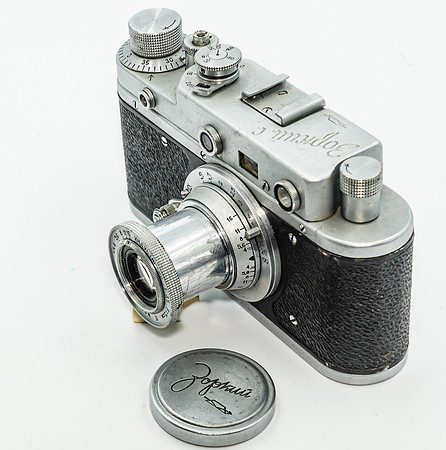
The Zorki C was introduced as a modernization of the Zorki‑1/2 family, specifically to add flash synchronization, which had become essential for press and amateur photography worldwide.
Production
• Years: 1955–1958
• Estimated quantity: ~473,000 units
• Position in the lineup:
• Preceded by: Zorki‑1, Zorki‑2
• Followed by: Zorki‑2C (same body, improved shutter reliability)
2. Design and Construction
Core identity
The Zorki C is fundamentally a Leica II copy, but with a redesigned top plate to accommodate flash sync. It preserves:
• bottom loading,
• separate viewfinder and rangefinder windows,
• compact Barnack proportions,
• cloth horizontal shutter.
Key technical features
• Lens mount: M39 LTM
• Standard lenses: Industar‑22 or Industar‑50 (50mm f/3.5)
• Shutter speeds: 1/25–1/500 + B
• Flash sync: PC socket with adjustable delay (0–25 ms)
• Loading: bottom-loading, removable baseplate
• Rangefinder: 1:1 magnification, separate from viewfinder
• Body: die‑cast alloy, chrome finish
What changed from Zorki‑1
• Taller, more angular top plate
• New shutter timing mechanism
• Flash sync port added
• Repositioned windows
• Slightly heavier and more robust body
3. Why the Zorki C Matters
1. First flash‑synchronized Zorki
This is the defining feature.
KMZ had to redesign the shutter timing and top plate — a major engineering step beyond simple Leica copying.
2. Last “true Barnack” Soviet camera
After the Zorki C/2C, KMZ moved to:
• combined viewfinder/rangefinder windows,
• larger bodies,
• different shutter mechanisms.
Thus, the Zorki C is the final evolution of the classic Leica II architecture in the USSR.
3. Transitional model toward modern Soviet rangefinders
It sits between:
• pure Leica clones (Zorki‑1, early FEDs), and
• Soviet-original designs (Zorki‑3, Zorki‑4).
Collectors value it as a bridge model.
4. Important for Soviet photographic culture
In the 1950s:
• flash photography became accessible,
• amateur clubs expanded,
• newspapers demanded synchronized cameras.
The Zorki C was the affordable Soviet answer to Western flash‑capable rangefinders.
5. Collectability
Collectors appreciate:
• its transitional status,
• multiple sub‑variants (8 types, 7 subtypes),
• early vs. late engraving differences,
• pairing with collapsible Industar‑22.
It is not rare, but historically important.
4. Variants and Identification Notes
The Zorki C has several identifiable variations:
• early vs. late shutter speed engravings,
• different sync delay markings,
• small changes in window frames,
• lens pairing differences (I‑22 vs I‑50)