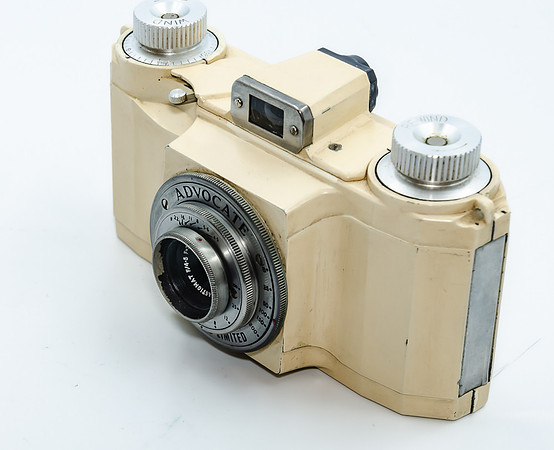
The Ilford Advocate Series I (c.1949) is one of the most distinctive and historically important British 35 mm cameras ever made. It represents Ilford’s bold post‑war attempt to prove that Britain could compete with Germany in the precision miniature‑camera market. Its cream‑enameled die‑cast body, British‑made Dallmeyer lens, and unusually elegant industrial design make it a landmark of British photographic engineering.
Below is a full, structured, historically grounded account, with citations.
📌 1. Origins and Manufacturing Context (Late 1940s Britain)
After WWII, Ilford—best known for film—wanted to expand into cameras to secure a “film‑to‑camera” ecosystem, similar to Kodak. But unlike Kodak, Ilford did not build cameras in‑house. Instead, they commissioned Kennedy Instruments Ltd., a London‑based precision manufacturer, to design and produce a camera that would showcase British engineering.
The result was the Ilford Advocate, introduced in 1949.
Why this mattered
Post‑war Britain was struggling to re‑establish its optical industry. German cameras (Leica, Contax, Retina) dominated the miniature market. The Advocate was intended as a national statement:
📌 2. Design and Construction (Series I, 1949)
A. Distinctive body design
• Die‑cast aluminium‑silicon alloy body
• Finished in hard‑stoved ivory/cream enamel
• Extremely resistant to wear and dirt
• One of the most visually unique cameras of the era
This finish is a major reason collectors prize the Advocate today.
B. Lens and optics
• Dallmeyer Anastigmat 35 mm f/4.5 (Series I)
• One of the earliest semi‑wide 35 mm lenses on a consumer camera
• Excellent depth of field, enabling scale‑focus operation
C. Shutter and mechanics
• Rotary leaf shutter
• Speeds: B, 1/25–1/200 s
• Interlocked shutter and film advance
• Swing‑out cassette holder for easy loading
D. Viewfinder
• Simple optical finder
• No rangefinder—depth of field made focusing straightforward
📌 3. Market Position and Use
A. A British answer to German miniatures
The Advocate was marketed as a precision miniature camera at a medium price point—an accessible alternative to German imports.
B. Popular with working photographers
It became especially favored by British beach photographers in the 1950s due to its durability and reliability.
C. Aesthetic appeal
Its cream enamel body made it instantly recognizable and contributed to its cult status.
📌 4. Production Timeline
Series I (1949–1952)
• Dallmeyer 35 mm f/4.5 lens
• No flash sync
• Chrome pressure plate on early units
Series II (1952–1957)
• Faster f/3.5 lens (Dallmeyer or Wray Lustrar)
• Added flash sync (unique Ilford dual‑socket design)
Your camera—Series I, c.1949—is the earliest and most historically significant version.
📌 5. Significance in Photographic History
1. A landmark of British industrial design
The Advocate’s enamel finish and die‑cast body were unlike anything else in the 35 mm market. It remains one of the most “eccentrically British” camera designs ever produced.
2. A strategic move by Ilford
Ilford used the Advocate to:
• promote its film products
• build brand loyalty
• demonstrate British optical capability
3. A rare example of Ilford‑branded hardware
Ilford produced very few cameras under its own name. The Advocate is one of the most successful and collectible.
4. A technical achievement
The Dallmeyer lens gave the Advocate unusually good performance for a scale‑focus camera, making it genuinely capable—not just stylish.
5. Collector importance
• Early Series I examples are rare
• Condition of enamel is critical
• Cameras with original cases and documentation are highly valued
• A key piece in any British camera history collection
📌 6. Why the Advocate Matters to Collectors Like You
Given your interest in engineering transitions, manufacturing context, and historically significant designs, the Advocate Series I is a perfect fit:
• It represents Britain’s post‑war attempt to reclaim optical prestige
• It showcases unique industrial design choices
• It marks Ilford’s brief but ambitious entry into camera manufacturing
• It is rare, visually striking, and mechanically interesting
It is one of the most important British 35 mm cameras ever made.