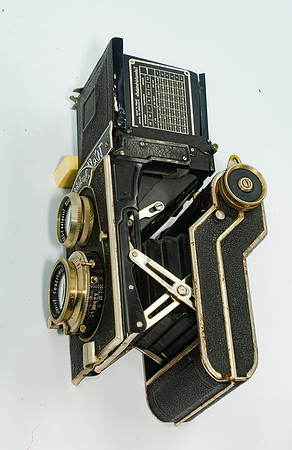
Welta Perfekta (c.1930s): History, Construction & Significance
The Welta Perfekta is one of the rarest and most technically fascinating cameras of the 1930s—a folding twin‑lens reflex (TLR) made in Freital, near Dresden. It represents a unique engineering experiment: combining the compactness of a folding camera with the focusing precision of a TLR.
Below is a clear, structured history based on the most authoritative sources available.
🏭 1. Origins & Manufacturing Context
Welta-Kamera-Werk (Freital, Germany)
• Founded in 1914, Welta became known for mid‑priced folding cameras before WWII.
• By the early 1930s, Dresden was the world’s most innovative camera‑making region, and Welta was competing with Balda, Certo, and Zeiss Ikon.
Development of the Perfekta
• The Perfekta was first shown around 1933, likely at the Leipzig Spring Fair.
• Production probably began in 1934, based on factory records and contemporary catalogues.
• It preceded the larger 6×9 cm Superfekta, which debuted around 1935.
Why it was unusual
Only two folding TLRs for 120 film were ever made:
• Zeca‑Flex
• Welta Perfekta
This makes the Perfekta exceptionally rare.
🔧 2. Technical Construction & Features
Format
• 120 roll film, producing 12 exposures of 6×6 cm.
• Some early literature mentions 6×9 capability, but the production Perfekta is a 6×6 camera.
Lens & Shutter Options
Common combinations included:
• Zeiss Tessar 75 mm f/3.8
• Schneider Xenar 75 mm f/3.8
• Meyer Trioplan 75 mm f/3.5
• Compur or Compur Rapid shutters (up to 1/500 s).
Folding TLR Mechanism
The Perfekta’s engineering is what makes it extraordinary:
• The camera folds flat like a normal 120 folder.
• When opened, a mirror drops into place behind the viewing lens, creating a waist‑level TLR focusing system.
• The lensboard is held rigid and parallel to the film plane by a patented strut system.
• Ground‑glass focusing with a pop‑up magnifier.
Body & Build
• Metal body with leather covering
• Leather bellows
• Nickel‑plated fittings
• Automatic frame counter with “A/E” (Aus/Ein = Off/On) positions
🌍 3. Historical Significance
⭐ 1. One of the rarest camera designs ever produced
Folding TLRs were mechanically complex and expensive to build.
The Perfekta is therefore a true oddity in camera history, produced in small numbers and seldom seen today.
⭐ 2. A pinnacle of Dresden engineering creativity
The Perfekta reflects the experimental spirit of 1930s German camera makers, who were pushing boundaries in:
• compactness
• precision focusing
• mechanical innovation
⭐ 3. A bridge between TLR and folding camera traditions
Before Rolleiflex dominated the TLR market, Welta attempted to merge:
• the portability of a folding camera
• the focusing accuracy of a TLR
This hybrid concept was never widely adopted, making the Perfekta historically important as a technological dead‑end—but a brilliant one.
⭐ 4. A highly collectible pre‑war rarity
Collectors value the Perfekta for:
• its scarcity
• its unusual folding‑TLR mechanism
• its association with the Dresden camera industry
• its high‑quality lenses and shutters
🧭 4. Why the Welta Perfekta Matters Today
It represents:
• A unique engineering experiment in the evolution of medium‑format cameras
• The peak of Welta’s pre‑war innovation
• One of the most unusual mechanical designs in 20th‑century photography
To collectors and historians, it is:
• Museum‑grade
• Mechanically fascinating
• A rare survivor of a short‑lived design philosophy