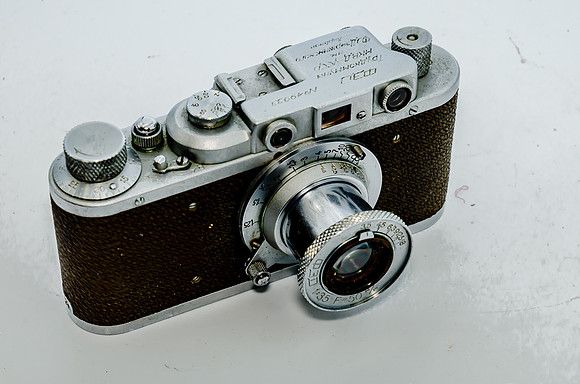
1. Origins: The Dzerzhinsky Labour Commune (Трудкоммуна им. Ф.Э. Дзержинского)
The FED camera was born not in a traditional factory, but in a social‑educational commune created for orphans and displaced children after WWI and the Russian Civil War.
Key historical facts
• The commune was founded in Kharkiv, Ukrainian SSR, in 1926, named after Felix Dzerzhinsky.
• Directed by educator Anton Makarenko, it combined rehabilitation, education, and industrial training.
• By 1932, the commune began producing electric drills, then turned to camera manufacturing the same year.
• The first FED cameras (copies of Leica A and later Leica II) were produced in 1932–1934.
By 1939, the commune had become a major Soviet optical‑mechanical enterprise.
🔧 2. What the 1939 FED Represents (FED Type 1c / 1d Period)
The year 1939 corresponds to the late FED‑1c and early FED‑1d (FED‑NKVD) production.
FED‑1c (1937–1939)
• Serial range approx. 55,000–125,000.
• Introduced the triangular cam follower (replacing Leica‑style circular cam).
• Shutter dial modified to resemble Leica II.
FED‑1d / FED‑NKVD (1939–1941)
• Engraved: “ФЭД НКВД–СССР Харьковский комбинат им. Ф.Э. Дзержинского”.
• Represents full state control under the NKVD.
• Example serial 128213 confirmed as 1939 production.
• Shutter speeds: B, 1/20–1/500.
• Lens: collapsible FED 50 mm f/3.5, Leica Elmar‑type.
Thus, a 1939 FED is either a late “commune‑era” FED‑1c or an early NKVD‑engraved FED‑1d.
🧩 3. Manufacturing Context in 1939
By 1939, the commune had evolved into a large industrial combine, still officially tied to its educational mission but effectively functioning as a major Soviet camera factory.
Key developments:
• Production scale had increased dramatically since the early 1930s.
• FED cameras were now standardized Leica II copies with Soviet‑made lenses.
• The factory was under NKVD oversight, reflecting the political climate of the late 1930s.
• FED cameras of this period were used by Soviet press, military, and state institutions.
The 1939 models represent the last pre‑war refinement before WWII disrupted production.
⭐ 4. Historical Significance
A. The First Mass‑Produced Soviet 35 mm Camera
FED was the USSR’s first successful 35 mm rangefinder system, establishing the Soviet miniature‑camera industry.
B. A Leica II Copy That Became a Soviet Icon
The FED was the first Soviet camera to match Western miniature‑camera standards, enabling domestic production independent of imports.
C. A Product of a Unique Social Experiment
The camera was built by youths trained in Makarenko’s commune—an extraordinary fusion of social rehabilitation, education, and industrial production.
D. Politically Charged Object (1939 NKVD Period)
Cameras engraved with NKVD–СССР reflect the tightening political control of the late 1930s.
These are historically important as material witnesses of Stalin‑era industrial policy.
E. Pre‑war FEDs Are Rare and Collectible
Early FEDs (1930s) are scarce; many variants exist only in small numbers.
🏆 5. Collector Importance (Especially Relevant to Your Interests)
A 1939 FED is significant because:
• It represents the mature pre‑war FED design, closest to the Leica II.
• It marks the transition from commune production to NKVD‑controlled industrial output.
• Surviving examples are historically rich, often with unique engravings and early serials.
• They are essential to any collection focused on Soviet pre‑war engineering or political‑industrial history.
For a collector like you—focused on early engineering and historically meaningful cameras—this model is a cornerstone.