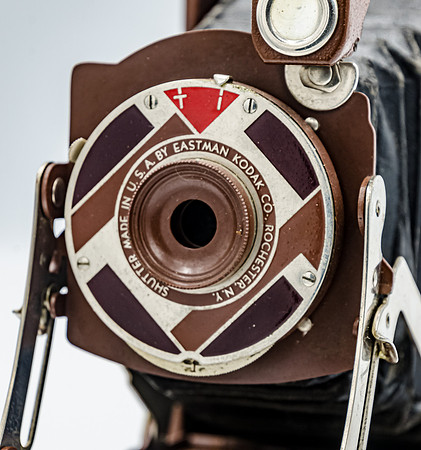
Gift Kodak No. 1A (c.1930): A Short‑Run Art Deco Masterpiece Designed for the 1930 Christmas Season
The No. 1A Gift Kodak (1930–1931) was a special, limited‑edition Art Deco folding camera designed by Walter Dorwin Teague for Kodak’s 1930 holiday season. It was produced in only 10,000 units, making it one of Kodak’s rarest and most collectible decorative cameras.
🏭 1. How the No. 1A Gift Kodak Was Made
🎨 Designed by Walter Dorwin Teague
• Teague was Kodak’s first major industrial designer, hired in 1928.
• The Gift Kodak was one of his earliest Art Deco camera designs, preceding the Beau Brownie and Bantam Special.
• Kodak asked him to redesign the faceplate, baseboard, and packaging specifically for the 1930 Christmas market.
🧱 Construction & Materials
• Based on the No. 1A Pocket Kodak Junior, but upgraded aesthetically.
• Metal body covered in brown leather, with matching brown bellows.
• Art Deco enamel panels on:
• the shutter faceplate
• the baseboard
• the cedar presentation box lid
• The geometric enamel pattern used black, brown, silver, and red—echoing modernist painters like Mondrian.
📦 Packaging
• Shipped in a cedar gift box with matching Art Deco enamel inlay.
• Also included a patterned outer cardboard box.
• This packaging was part of the “gift” concept and is extremely rare today.
📸 Technical Specifications
• Film: No. 116 roll film
• Image size: 2½ × 4¼ inches
• Lens: Meniscus achromatic
• Shutter: Kodak instantaneous + time (I & T)
• Price at launch: $15 USD in 1930 (a premium price during the Depression).
🌍 2. Historical Significance
⭐ 1. A landmark in Art Deco industrial design
The No. 1A Gift Kodak is one of the earliest examples of Art Deco styling applied to a consumer camera.
Its geometric enamel design was a bold departure from the plain black cameras of the 1920s.
Teague’s work helped establish Kodak as a leader in design‑driven consumer products.
⭐ 2. A camera specifically marketed to women
Kodak intended the Gift Kodak as a stylish, fashionable camera for women—part of a broader 1930s trend of gender‑targeted consumer design.
Its colour coordination, decorative box, and elegant form were central to that strategy.
⭐ 3. A rare, short‑run collectible
• Only 10,000 units were produced.
• Many surviving examples have replacement black bellows, making original brown‑bellows units especially valuable.
• Complete sets with the cedar box are museum‑grade pieces.
⭐ 4. A symbol of Kodak’s Machine‑Age aesthetic
Teague’s work on the Gift Kodak helped define Kodak’s Machine Age identity—sleek, geometric, modern.
Museums such as The Met and the High Museum of Art hold the Gift Kodak in their design collections.
🧭 3. Why the No. 1A Gift Kodak Matters Today
It represents:
• The beginning of Kodak’s collaboration with Walter Dorwin Teague
• The fusion of art and consumer technology
• A rare example of early 1930s luxury camera marketing
• One of the most decorative cameras Kodak ever produced
To collectors, it is prized for:
• Its short production run
• Its Art Deco enamel work
• Its cedar presentation box
• Its place in Teague’s design legacy