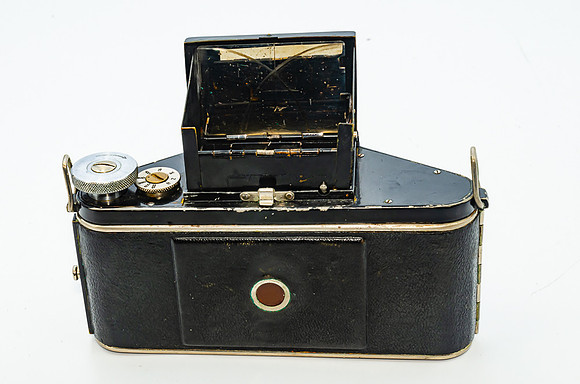
VP Exakta (1933): The First Practical SLR and the Direct Ancestor of All Modern 35 mm SLRs
The VP Exakta of 1933 was the world’s first successful single‑lens reflex camera for roll film, built by Ihagee in Dresden. It introduced interchangeable lenses, a focal‑plane shutter up to 1/1000 s, and the system‑camera concept—features that directly shaped every SLR that followed.
Below is a clear, historically grounded explanation of its making and significance.
🏭 1. How the VP Exakta Was Made (Dresden, 1933)
🏭 Manufacturer: Ihagee Kamerawerk, Dresden
• Dresden in the 1930s was the global centre of camera innovation, home to Zeiss Ikon, Welta, Balda, Certo, and Ihagee.
• Ihagee specialised in precision cameras and reflex mechanisms, and the VP Exakta was their first major breakthrough.
🛠️ Design & Engineering
• Designed by Karl Nüchterlein, Ihagee’s brilliant young engineer.
• Built around 127 “Vest Pocket” roll film, producing 4×6.5 cm negatives—large for an SLR, but still portable.
• Body made from metal castings with leather covering, and a trapezoidal shape that later became iconic.
🔧 Key Mechanical Features
• Focal‑plane cloth shutter with speeds from 1/25 to 1/1000 s—astonishing for 1933 and faster than contemporary Leica shutters.
• Interchangeable lenses, including Tessar, Biotar, and Xenar options.
• Waist‑level reflex viewing with a ground‑glass screen.
• System‑camera accessories: close‑up devices, filters, finders, and more—unusual for the early 1930s.
📦 Model Variants (1933–1936)
• Exakta A (1933) – the original model (later named “A” after the B appeared).
• Exakta B (late 1933) – added slow speeds (12 s to 1/10 s) and a self‑timer.
• Night Exakta – optimized for long exposures.
🌍 2. Historical Significance
⭐ 1. The First Practical SLR for Roll Film
Earlier SLRs existed, but they were bulky plate cameras.
The VP Exakta was the first compact, portable SLR that ordinary photographers could carry and use handheld.
It introduced the SLR as a mainstream photographic tool.
⭐ 2. The Direct Predecessor of the First 35 mm SLR
The VP Exakta directly led to the Kine Exakta (1936)—the world’s first successful 35 mm SLR.
Every 35 mm SLR from the 1930s to the digital era traces its lineage to this design.
⭐ 3. A System Camera Before Leica or Contax Offered SLR Systems
Ihagee’s accessory ecosystem—lenses, close‑up attachments, finders—was revolutionary.
It positioned the Exakta as a precision instrument, not just a consumer camera.
⭐ 4. Technically Advanced for Its Time
• 1/1000 s shutter speed
• Interchangeable lenses
• Reflex focusing
• Modular accessories
These features were unmatched by most cameras of the early 1930s.
⭐ 5. A Dresden Engineering Icon
The VP Exakta helped cement Dresden’s reputation as the metropolis of the German photo industry, a status it held until WWII.
🧭 3. Why the VP Exakta Matters Today
For Collectors
• Early SLR design → historically important
• Multiple variants → collectible diversity
• Pre‑war Dresden craftsmanship → high desirability
For Photographic History
• It is the starting point of the SLR lineage.
• Without the VP Exakta, the Kine Exakta—and thus the entire 35 mm SLR revolution—would not exist.
For Engineering Enthusiasts
• A fascinating example of early shutter design
• Innovative reflex mechanism
• A true system camera decades ahead of its time