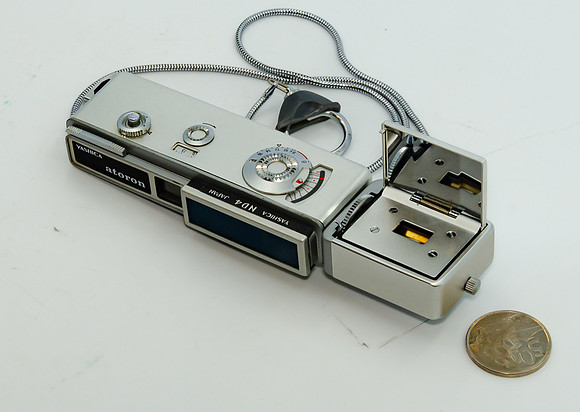
Origins and Manufacturing Context
Japan’s camera industry in the late 1960s
By 1968, Japan had become the world’s leading camera manufacturer.
Yashica—already known for its TLRs and the Electro 35—wanted to expand into:
• the premium compact segment,
• the subminiature market,
• and the growing demand for stylish, pocketable cameras.
The Atoron was introduced around 1965–1968 (depending on market), produced in Japan, and aimed at:
• business professionals,
• travelers,
• and the “spy camera” enthusiast market that Minox had created.
Design Philosophy
Unlike the purely functional Minox, the Atoron was designed to be:
• sleek,
• jewel‑like,
• luxurious,
• and easy to use.
It was marketed as a fashionable, high‑quality miniature rather than a technical instrument.
🔧 2. Technical Design and Construction
Core Specifications
• Film: 8×11 mm Minox‑type cartridges (Yashica‑branded).
• Lens: 15 mm f/2.8 Yashinon (4‑element design).
• Shutter: 1/30–1/250 s + B.
• Focusing: 0.5 m to infinity, via distance scale.
• Body: chrome‑plated metal, extremely compact and solid.
• Metering: selenium cell (on the Atoron Electro, CdS).
Build Quality
The Atoron is beautifully machined:
• smooth sliding action,
• precise focusing,
• excellent lens performance for the tiny format.
It feels more like a piece of jewelry than a camera—very much in line with late‑1960s Japanese industrial design.
Variants
• Atoron (original) — selenium meter, classic chrome finish.
• Atoron Electro (1970) — CdS metering, black/chrome styling.
• Atoron Mini — simplified version for mass market.
🌍 3. Significance in Photographic History
A. Japan’s answer to Minox
The Atoron was one of the few serious Japanese attempts to challenge Minox in the 8×11 mm category.
It offered:
• a faster lens (f/2.8 vs Minox’s f/3.5),
• a more modern aesthetic,
• simpler operation.
It never dethroned Minox, but it proved that Japan could produce subminiatures of equal or better quality.
B. A symbol of 1960s miniaturisation culture
The late 1960s saw a fascination with:
• micro‑electronics,
• spy gadgets,
• ultra‑compact design.
The Atoron fit perfectly into this cultural moment—small enough to hide in a pocket, stylish enough to show off.
C. A bridge between mechanical and electronic eras
The original Atoron is fully mechanical with selenium metering.
The later Atoron Electro introduced CdS metering and battery‑powered exposure control, reflecting the industry’s shift toward electronics.
D. A prestige object in Yashica’s lineup
While Yashica was not known for luxury products, the Atoron was marketed as a premium miniature, helping elevate the brand’s image internationally.
🎞️ 4. Collectability and Legacy
Why collectors value the Atoron:
• Beautiful industrial design—one of the most elegant subminiatures ever made.
• High optical quality from the Yashinon lens.
• Cold War “spy camera” appeal.
• Short production runs compared to Minox.
• Japanese craftsmanship at a transitional moment in camera history.
Market notes
• Selenium meters often no longer function, but the camera remains usable.
• Atoron Electro models are rarer and more sought after.
• Original Yashica 8×11 cartridges add value.
🧭 5. Why this camera matters in your collecting framework
Given your deep interest in miniaturisation engineering, Cold War optical history, and Japanese innovation, the Atoron is a perfect fit because it represents:
• Japan’s interpretation of the Minox concept,
• a design‑driven approach to subminiature photography,
• a bridge between mechanical precision and early electronics,
• and a distinctive cultural artifact of the late 1960s.
It’s a small camera with a big story—exactly the kind of piece that enriches a historically grounded collection.