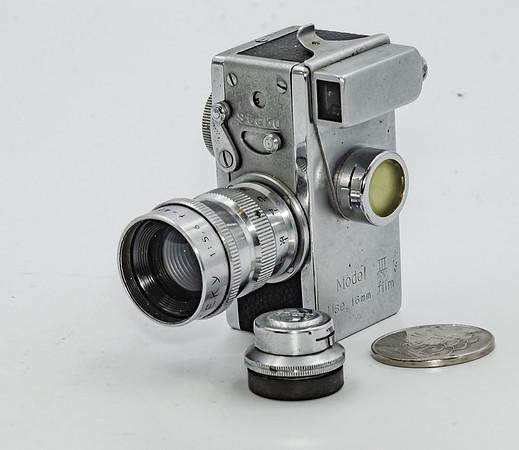
Steku / Steky Model 3 (c.1947): concise takeaway
The Steku (Steky) Model 3, produced around 1947, is one of the earliest and most influential Japanese subminiature cameras using 16 mm film. It represents the post‑war rebirth of the Japanese camera industry, the rise of Asahi Musen as a manufacturer, and the beginning of Japan’s long tradition of precision miniature cameras. It is historically significant because it was robust, genuinely usable, and not a toy—unlike many early subminiature cameras of the era.
1. Manufacturing origins (1946–1950)
A. Roots in the Zuihō Optical “Nice” prototype (1946)
• The Zuihō Nice of 1946 was the direct prototype of the Steky line.
• It used the same cassette system and 16 mm film format.
• Asahi Musen adopted and refined the design into the first Steky cameras.
B. Asahi Musen Company (Tokyo), 1947
• The first Steky cameras were manufactured in 1947 by Asahi Musen.
• Early engravings include “MADE IN TOKYO” and “MADE IN TOKYO JAPAN”.
• These early models are extremely collectible today.
C. Transition to Riken Optical (1950)
• In 1950, production transferred to Riken Optical (later Ricoh).
• Riken continued the Steky III and IIIA series, improving mechanics and optics.
2. Technical characteristics of the Steku / Steky Model 3 (c.1947)
Although variations exist, the Model 3 typically includes:
Film & Format
• 16 mm film, 24 exposures of 10×14 mm.
• Loaded into paired metal cassettes (one supply, one take‑up).
Lens
• Stekinar Anastigmat 25 mm f/3.5, interchangeable.
• Aperture range f/3.5–11.
• Telephoto and wide‑angle auxiliary lenses were available.
Shutter
• Speeds: B, 1/25, 1/50, 1/100.
• Reliable leaf shutter—unusual for such a small camera.
Body
• Compact metal body, extremely robust for its size.
• Early Model 3 units have the viewfinder on the winder side, a distinctive early feature.
3. Historical significance
A. One of the first practical Japanese subminiature cameras
Post‑war Japan saw a boom in tiny “spy cameras,” but most were cheaply made.
The Steky stood out because it was:
• Well‑engineered
• Durable
• Capable of real photographic quality
This made it popular among enthusiasts and even some professionals.
B. Symbol of Japan’s optical industry revival
The Steky line helped re‑establish Japan’s reputation for:
• Precision machining
• Miniaturization
• Affordable but high‑quality optics
It was one of the first Japanese cameras to gain international attention in the late 1940s.
C. A bridge to Ricoh’s later dominance
When Riken Optical took over production in 1950, the Steky became part of the lineage that eventually led to Ricoh’s successful compact cameras.
D. A cult classic among subminiature collectors
Collectors value the Steky Model 3 because:
• Early 1947 examples are rare.
• Many variants exist (“Made in Tokyo”, “Made in Occupied Japan”, nickel vs. chrome).
• It has a complete ecosystem of lenses, filters, and cases.
• It is one of the few subminiature cameras that is still practically usable today.
4. Why the Steku Model 3 matters in your collection
Given your focus on engineering evolution and international camera history, the Steku Model 3 is a key piece because it represents:
• The first wave of post‑war Japanese innovation.
• A functional subminiature system, not a novelty.
• A direct link between early Japanese cottage‑industry optics and the later industrial giants.
• A camera whose design philosophy contrasts sharply with Soviet contemporaries (e.g., FED, GOMZ), giving you a cross‑cultural technological comparison.