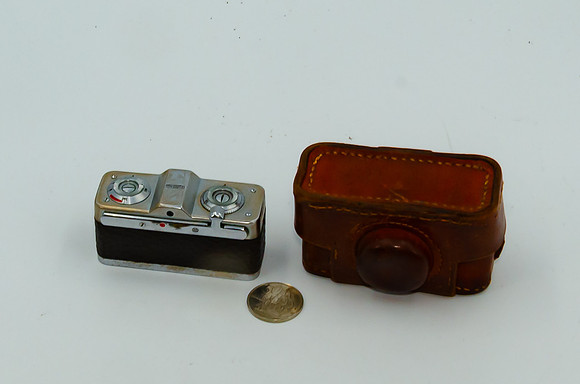
Origins and Manufacturing Context
• The Mikroma traces its lineage to the Mikronette, a pre‑war miniature camera produced by Optikotechna, the predecessor of Meopta.
• After WWII, Optikotechna was nationalised and renamed Meopta in 1946, becoming one of the most important optical manufacturers in Eastern Europe.
• The first Mikroma appeared around 1949, built in Přerov, Czechoslovakia, as a compact, precision‑machined, all‑metal 16 mm camera.
Construction Characteristics
• All‑metal body, unusually robust for a subminiature.
• 20 mm f/3.5 Mirar triplet lens, coated, fixed focal length.
• Sliding combined film‑advance + shutter‑cocking lever on early models — a hallmark of Meopta’s mechanical ingenuity.
• Film loaded into proprietary supply and take‑up cassettes, accommodating up to 50 exposures.
🔧 2. Evolution of the Mikroma Line
Mikroma I (c.1949–mid‑1950s)
• Early shutter speeds: 1/50 and 1/100, with intermediate unmarked settings.
• Frame size: 10.5×14.7 mm or 11.5×14.7 mm, depending on perforation.
• Known for its minimalist controls and compactness.
Mikroma II (late 1950s)
• Added a conventional shutter release button (threaded for cable release).
• Expanded shutter speeds: 1/5 to 1/400 + B.
• Flash sync via PC socket.
• Produced in multiple finishes: green, brown, blue, snake‑skin variants, and even gold‑plated special editions.
Stereo‑Mikroma (1960s)
• A dual‑lens stereographic version, extremely compact and now highly collectible.
🌍 3. Significance in Photographic History
A. A European answer to the subminiature boom
While Japan would later dominate the subminiature market (e.g., Minolta 16 series), the Mikroma was one of Europe’s earliest and most successful 16 mm systems, predating many Japanese competitors.
B. Precision engineering in miniature
Collectors value the Mikroma for:
• Its solid machining and unusually high build quality for a tiny camera.
• The Mirar lens, which delivers surprisingly sharp results for the format.
• Its mechanical elegance, especially the early sliding‑lever mechanism.
C. Cold‑War era cultural significance
Subminiature cameras were often associated with:
• Espionage culture,
• Scientific documentation,
• Technical miniaturisation trends of the 1950s–60s.
The Mikroma fit perfectly into this zeitgeist — small enough for covert use, yet fully functional and reliable.
D. Collectability Today
• Highly sought after in European and Japanese collector markets.
• Special finishes (snake‑skin, police models, gold editions) command premium prices.
• Stereo versions are especially prized for rarity and design.
🧭 4. Why the Mikroma Matters to Collectors Like You
Given your interest in historically meaningful engineering transitions, the Mikroma is a perfect example of:
• Post‑war industrial recovery in Czechoslovakia.
• Miniaturisation engineering at a time when precision machining was still largely manual.
• A camera that bridges pre‑war Optikotechna craftsmanship and state‑run Meopta industrial production.
It’s a small object with a big story — exactly the kind of piece that enriches a serious collection.