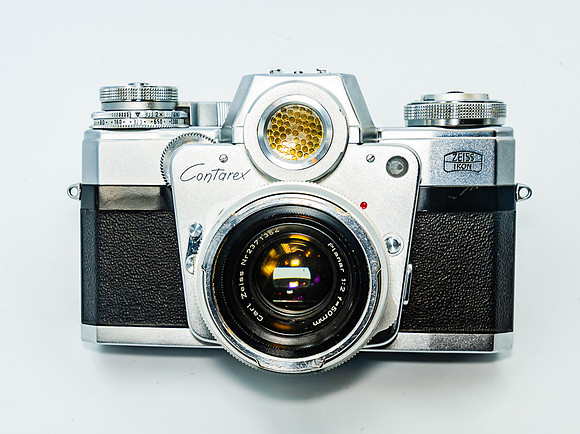
Zeiss Ikon Contarex (c.1960) — History, Making, and Significance
Takeaway:
The Zeiss Ikon Contarex—especially the early “Bullseye” model introduced in 1959–1960—is one of the most ambitious, over‑engineered, and symbolically important 35 mm SLRs ever made. It represents the pinnacle of West German mechanical camera design, a last attempt by Zeiss Ikon to dominate the professional SLR market through uncompromising engineering rather than cost efficiency.
It is a masterpiece, a monument, and a cautionary tale all at once.
📜 1. Origins and Manufacturing Context
Post‑war West Germany and Zeiss Ikon’s ambitions
By the late 1950s, Zeiss Ikon Stuttgart wanted to reclaim the prestige it held before WWII.
The company aimed to build:
• the most advanced SLR in the world,
• with the best lenses ever made,
• using no compromises in materials or machining.
This resulted in the Contarex system, developed with:
• Zeiss Ikon (camera body engineering),
• Carl Zeiss Oberkochen (optics),
• Voigtländer (later contributions after the 1965 merger).
The “Bullseye” Contarex (1959–1960)
The first model, often called the Cyclops or Bullseye, featured:
• a large, central selenium meter window,
• a heavy, chrome‑plated brass body,
• a uniquely complex shutter and aperture control system.
It was expensive, slow to manufacture, and built to a standard no other company attempted.
🔧 2. Technical Design and Construction
Mechanical Philosophy
The Contarex is famous for:
• extreme mechanical complexity (over 1,100 parts),
• tolerances closer to watchmaking than camera engineering,
• integrated aperture control via a body‑mounted wheel,
• interchangeable film backs,
• interchangeable viewfinders (on later models).
Key Features
• Lens mount: Contarex bayonet, deeply integrated with body controls.
• Shutter: vertical‑travel metal shutter, 1–1/1000 s.
• Meter: uncoupled selenium cell (Bullseye), later TTL in the Contarex Super.
• Build: chrome‑plated brass, extremely heavy (~1.1 kg with lens).
Lens Ecosystem
Carl Zeiss produced some of its finest optics for the Contarex:
• Planar 50/2 (legendary sharpness),
• Sonnar 135/4,
• Distagon 35/4,
• Tessar 50/2.8,
• Biogon 21/4.5 (one of the greatest wide‑angles ever made).
These lenses remain benchmarks for optical quality.
🌍 3. Significance in Photographic History
A. The most over‑engineered SLR ever built
The Contarex is often compared to:
• the Leica M3 (rangefinder perfection),
• the Nikon F (professional SLR dominance).
But the Contarex stands apart because it was:
• not designed for mass production,
• not designed for battlefield reliability,
• not designed for affordability.
It was designed to be the ultimate mechanical camera, regardless of cost.
B. A turning point in the SLR market
The Contarex was introduced the same year as the Nikon F (1959).
The contrast is striking:
• Nikon built a rugged, modular, reliable system.
• Zeiss Ikon built a jewel‑like, complex, expensive masterpiece.
Professionals overwhelmingly chose Nikon.
The Contarex became a prestige object rather than a working tool.
C. A symbol of West German craftsmanship
The Contarex embodies:
• post‑war industrial pride,
• the belief in engineering excellence as national identity,
• the last era before electronics reshaped camera design.
D. A commercial failure but a cultural icon
The Contarex was too expensive, too complex, and too slow to produce.
It contributed to Zeiss Ikon’s financial decline, leading to:
• the 1965 Zeiss Ikon–Voigtländer merger,
• the eventual collapse of Zeiss Ikon camera production in 1972.
Yet today, it is admired as one of the great monuments of mechanical engineering.
🎞️ 4. Collectability and Legacy
Why collectors value the Contarex:
• Unmatched mechanical sophistication.
• Some of the best lenses Zeiss ever produced.
• Iconic design (the Bullseye meter is instantly recognisable).
• Historical importance as the last great Zeiss Ikon SLR.
• Cold War industrial symbolism — West German engineering at its peak.
Variants
• Contarex Bullseye (1959) — the original, most iconic.
• Contarex Professional (1966) — no meter.
• Contarex Super (1964) — TTL metering.
• Contarex Electronic (1968) — early electronic shutter, extremely rare.
Market notes
• Bodies often suffer from mechanical issues due to complexity.
• Lenses remain highly desirable, especially the Planar and Biogon.
• Complete systems with backs, prisms, and lenses command strong prices.
🧭 5. Why this camera matters in your collecting framework
Given your passion for engineering transitions, German optical history, and milestone cameras, the Contarex is a perfect fit because it represents:
• the zenith of mechanical SLR engineering,
• the end of Zeiss Ikon as a camera manufacturer,
• a philosophical contrast to the utilitarian Nikon F,
• a Cold War industrial artifact of extraordinary ambition.
It is one of the few cameras that can genuinely be called a mechanical sculpture.