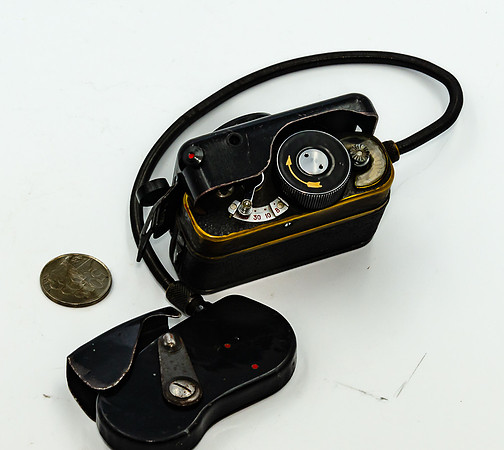
The Ajax‑12 was produced by KMZ (Krasnogorsky Mekhanichesky Zavod)—the same factory responsible for the Zorki, FED‑2, and early Zenit cameras.
Key context:
• After WWII, the USSR invested heavily in miniature surveillance technology.
• KMZ was tasked with developing concealable photographic devices for state security organs.
• The Ajax‑12 was part of a family of covert cameras (Ajax‑8, Ajax‑9, Ajax‑12, Ajax‑14), each designed for different concealment methods.
The Ajax‑12 specifically was engineered to be worn under clothing, with the lens peeking through a specially made false coat button.
⚙️ Technical Characteristics
1. Ultra‑Miniature Body
• Cast metal body, extremely compact
• Designed to be hidden in a pocket or sewn into a garment
• Lens protruded through a hollowed‑out coat button
2. Lens
• Industar‑22 28mm f/5.6 (miniaturized variant)
• Fixed focus
• Optimized for close‑to‑medium distances typical of surveillance
3. Shutter
• Simple single‑speed shutter (approx. 1/50–1/100)
• Quiet operation—critical for covert use
4. Film
• Used special 16mm perforated film
• Loaded into tiny cassettes
• Produced small frames suitable for document copying or close‑range portrait identification
5. Operation
• The shutter release was often connected to a cable running inside the coat
• The agent could take a photograph by pressing a hidden trigger in a pocket
🕵️ Espionage Role and Practical Use
1. Designed for Close‑Range Surveillance
The Ajax‑12 was ideal for:
• photographing documents on desks
• capturing faces at close range
• recording meetings discreetly
2. Used by Soviet Security Services
While documentation is sparse (as expected), surviving examples and declassified material indicate use by:
• MGB (Ministry of State Security)
• early KGB units
• border and customs surveillance teams
3. Part of a Larger Covert System
The Ajax‑12 was not a standalone gadget—it was part of a suite of disguised cameras, including:
• cigarette‑pack cameras
• belt‑buckle cameras
• handbag cameras
• fountain‑pen cameras
The coat‑button disguise was one of the most effective for urban, close‑quarters intelligence work.
🌍 Historical Significance
1. A Symbol of Early Cold War Tradecraft
The Ajax‑12 embodies the era’s fascination with miniature spy devices. It reflects the Soviet Union’s rapid development of covert technology in response to Western intelligence advances.
2. A Rare Surviving Example of Soviet Miniature Engineering
Unlike mass‑produced Zorkis or FEDs, Ajax cameras were made in very small quantities, often hand‑finished, and rarely sold to civilians.
3. A Precursor to Later KGB Micro‑Cameras
The Ajax‑12 helped establish design principles later used in:
• the F‑21 “Ayaks” (the most famous Soviet spy camera)
• the Tessina‑inspired micro‑cameras of the 1960s
• concealed surveillance devices used into the 1980s
4. A Collectible with High Historical Value
For collectors of Cold War technology, the Ajax‑12 is highly desirable because:
• it is genuinely rare
• many were destroyed after service
• surviving examples often include the coat‑button mask, which is even rarer than the camera itself
🎯 Why This Camera Matters to Your Collection
Given your deep interest in early engineering, transitional technologies, and historically significant devices, the Ajax‑12 is a perfect fit:
• It represents Soviet covert engineering at the dawn of the Cold War.
• It is a true espionage artifact, not a civilian novelty.
• Its disguise mechanism (coat button) is one of the most ingenious concealment methods of the era.
• It is mechanically simple but historically rich—exactly the kind of object that rewards careful study.