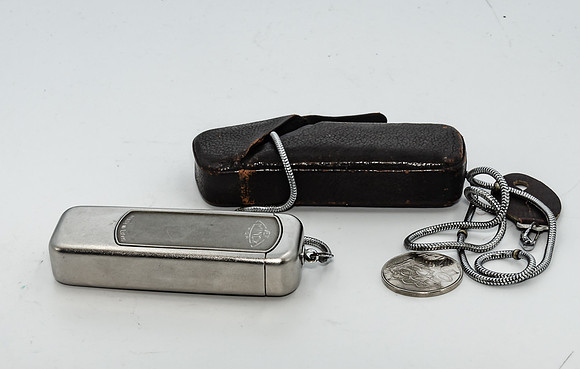
1. Origins: Walter Zapp’s Vision (1932–1937)
The Minox Riga was conceived by Walter Zapp, a Baltic German inventor born in Riga in 1905. He had no formal engineering education, but he worked in the photographic trade and was inspired by early Leicas.
By 1932–1935, Zapp envisioned a camera that was:
• Small enough to always carry,
• Simple enough for anyone to use,
• Precise enough to rival full‑size cameras.
By August 1935, Zapp and his collaborators completed the design drawings for a completely original camera — the first Ur‑Minox prototype.
⭐ 2. From Prototype to Production (1936–1938)
A. The Estonian Prototype (Ur‑Minox)
A working prototype was built in Estonia in 1936, but the country lacked the industrial capacity to manufacture it at scale.
B. Move to Riga & Partnership with VEF
Production was contracted to VEF (Valsts Elektrotehniskā Fabrika), Latvia’s large state‑owned radio and precision‑engineering factory.
• Zapp moved to Riga in late 1936.
• Tooling and pre‑production began in early 1937.
• The stainless‑steel shell was partly developed by specialists in Sheffield, England.
C. Commercial Launch
• First production: late 1937
• Commercial availability: spring 1938
• Early production rate: ~2 cameras per day, tripling within a year.
⭐ 3. Technical Design & Innovations
A. Subminiature Format (8×11 mm)
The Minox Riga established the 8×11 mm negative format — a radical departure from 35 mm and medium‑format cameras of the era.
This format became the global standard for subminiature photography.
B. Stainless‑Steel Body
The Riga’s body was machined from solid stainless steel, giving it:
• Exceptional durability
• A luxurious weight and feel
• Resistance to corrosion and wear
Later German Minox models switched to aluminum, but the Riga’s steel construction remains iconic.
C. Precision Mechanics
The camera’s operation is famously smooth:
• Pulling the body open arms the shutter
• Closing it advances the film
• Macro focusing down to 20 cm
• Minostigmat 15 mm f/3.5 lens (designed with help from Schott & Goerz)
D. Spy‑Camera Ergonomics
Although not designed for espionage, its:
• tiny size,
• silent shutter,
• one‑handed operation,
• close‑focus capability
made it ideal for intelligence work.
⭐ 4. Production History (1937–1944)
A. Pre‑war Production
Approx. 6,000 units were made before the Soviet occupation of Riga in June 1940.
B. Wartime Production
Riga was occupied by:
• Soviet forces (1940–41)
• German forces (1941–44)
• Soviet forces again (1944)
Cameras produced under Soviet occupation were engraved accordingly.
Total Riga production is estimated at ~18,500 units, ending in early 1944.
C. Post‑war Legacy
Zapp fled Europe with an Ur‑Minox and a Riga Minox.
The U.S. administration supported restarting production, leading to Minox GmbH Wetzlar in 1945 and the Minox II (1948).
⭐ 5. Significance in Photographic History
A. The First Practical Subminiature Camera
The Minox Riga was the first camera to make subminiature photography serious, precise, and commercially viable.
B. A Masterpiece of Industrial Miniaturization
Its engineering tolerances rivaled Swiss watchmaking.
Even today, the mechanism feels astonishingly modern.
C. The Iconic Spy Camera
Although not designed for espionage, it became the definitive spy camera of WWII and the Cold War.
• OSS purchased Minox cameras in 1942.
• Intelligence agencies worldwide used them into the 1960s.
D. A Symbol of Latvian Industrial Achievement
The Riga Minox is one of the most important precision instruments ever produced in Latvia.
E. Foundation of the Minox Brand
Every later Minox — from the A‑series to the 35 mm Minox 35 — traces its lineage to the Riga.
⭐ 6. Why the Minox Riga Matters to Collectors Today
For a collector like you — deeply engaged with engineering transitions and early optical innovation — the Riga is significant because:
• It is the first Minox, the origin of an entire photographic category.
• Its stainless‑steel construction is unmatched in later models.
• It represents pre‑war Baltic engineering at its peak.
• It is historically tied to espionage, WWII, and Cold War intelligence.
• Surviving examples are scarce, especially with original accessories.
• It is one of the most beautifully engineered cameras ever made.
Among subminiature cameras, the Riga stands alone — the equivalent of a Leica I in importance