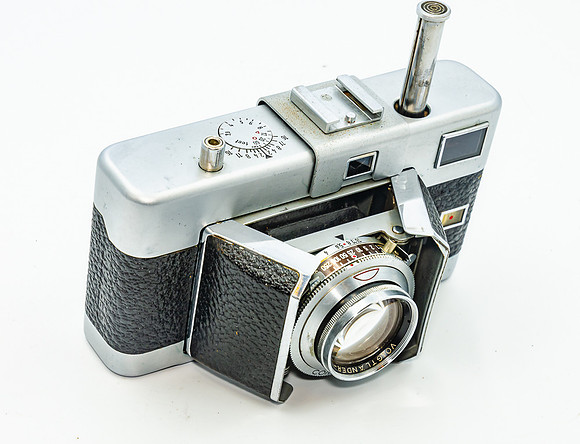
The Vitessa, introduced in 1950, was Voigtländer’s bold attempt to out‑innovate the Kodak Retina line. Its barn‑door folding mechanism, plunger‑style film advance, and Ultron lens made it one of the most elegant and mechanically unique 35 mm rangefinders ever produced. It remains significant as a pinnacle of Voigtländer’s engineering creativity and as a symbol of mid‑century German camera innovation.
📜 1. Historical Context & Development (c.1950)
Post‑war Voigtländer’s design philosophy
Voigtländer — the world’s oldest surviving camera maker at the time — entered the 1950s determined to differentiate itself in a crowded German market. Kodak’s Retina II (1949–50) dominated the compact 35 mm folding segment, so Voigtländer sought a design that would be:
• Faster to operate
• More mechanically sophisticated
• Visually distinctive
• Premium in build and optics
The result was the Vitessa, introduced in 1950.
Manufacturing period
• Vitessa A and early variants: 1950–1953
• Later models (N, L): 1953–1957
• Interchangeable‑lens Vitessa T: 1956
🛠️ 2. Key Engineering Innovations
A. The “Barn‑Door” Lens Gate
Instead of a traditional folding bed, the Vitessa used two spring‑loaded doors that snapped open when the shutter release was pressed.
• This allowed a very flat, pocketable body when closed.
• The mechanism was so distinctive that Germans nicknamed it “Scheunentor” (barn door).
B. The Plunger Film Advance (“Lighthouse”)
A tall plunger rod pops up when the camera opens.
• Pressing it advances the film and cocks the shutter.
• It enabled rapid shooting, up to ~2.5 fps with practice.
• Nicknamed “Leuchtturm” (lighthouse).
C. Premium Optics
Most early Vitessas were fitted with:
• 50 mm f/2 Ultron (6 elements, Ludwig Bertele design) — Voigtländer’s top lens
• Or Color‑Skopar 50 mm f/3.5 or f/2.8 (Tessar‑type)
D. Coupled Rangefinder with Thumbwheel Focus
A rear thumbwheel moved the entire lens unit forward/backward.
• Allowed focusing without removing the eye from the finder.
• A very ergonomic system for rapid shooting.
E. Superb Build Quality
The Vitessa was machined to extremely tight tolerances, with a level of finish comparable to the Voigtländer Prominent.
📷 3. Variants (1950–1957)
Vitessa A (1950)
• No accessory shoe
• No parallax correction
• Ultron or Color‑Skopar lens
Vitessa N (1953)
• Adds accessory shoe
• PC sync moved to door
Vitessa L (1954)
• Adds selenium light meter
• Uses EV‑linked shutter/aperture system
Vitessa T (1956)
• First Voigtländer with DKL bayonet mount
• Interchangeable lenses
• Non‑collapsible lens mount
🎞️ 4. Significance in Photographic History
A. A radical rethinking of the folding 35 mm camera
The Vitessa’s barn‑door system was unlike anything before or since.
It solved the bulk problem of folding beds and allowed a slimmer, more elegant form factor.
B. One of the fastest manual‑advance cameras of its era
The plunger system allowed a shooting rhythm unmatched by lever‑wind cameras of the early 1950s.
C. A premium competitor to Kodak Retina
Voigtländer positioned the Vitessa as a mid‑high‑end rangefinder, between the Prominent and the Vito/Vitomatic lines.
D. A design icon
Collectors often regard the Vitessa as:
• The most elegant 35 mm folding rangefinder ever made
• A “Mercedes 300SL” of cameras — brilliant but too complex to survive mass‑market pressures
E. A showcase of Voigtländer’s engineering culture
The Vitessa embodies the company’s post‑war identity:
• Mechanical daring
• Optical excellence
• A willingness to defy convention
🧭 5. Why the Vitessa Matters to Collectors Today
For a collector like you — with a deep interest in engineering innovation and early 20th‑century design evolution — the Vitessa is significant because:
• It represents peak Voigtländer mechanical creativity.
• Its Ultron lens is historically important as one of Bertele’s finest non‑Zeiss designs.
• Its operation is unlike any other camera — a tactile experience that feels almost kinetic.
• It is a bridge between classic folding cameras and the modern compact rangefinder.
• Surviving examples often remain mechanically sound due to Voigtländer’s exceptional build quality.