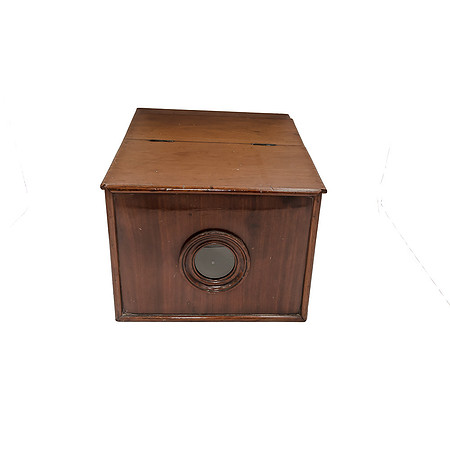
Camera Obscura c. 1790, The pictured model is for drawing and has a convex lens
Ancient & Medieval Origins
• 5th century BCE — Chinese philosopher Mozi describes the inverted-image phenomenon of a darkened room with a small aperture.
• 4th century BCE — Aristotle notes similar optical effects.
• c. 1030 CE — Arab scientist Alhazen (Ibn al-Haytham) gives the first detailed scientific explanation of the camera obscura.
🎨 Renaissance to Early Modern Development
• 1490s — Leonardo da Vinci documents the camera obscura extensively in his notebooks.
By c. 1790
By the late 18th century, the camera obscura had reached a mature, highly practical form:
• Compact box camera obscuras with:
• A convex lens for focusing
• An angled mirror to project the image upright
• A ground‑glass screen or drawing surface
• Widely used by artists for accurate perspective drawing.
The pictured model is for drawing and has a convex lens, circa 1790