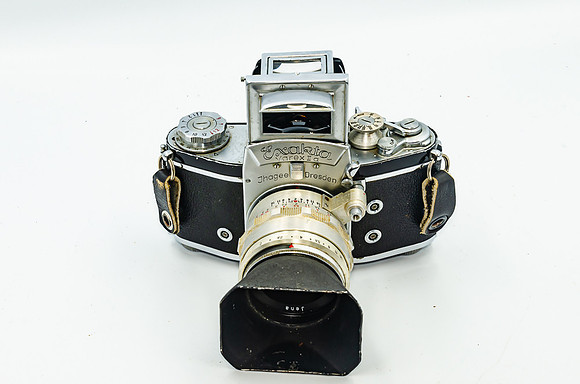
Origins and Manufacturing Context
Dresden: the cradle of the SLR
By the late 1950s, Ihagee had already revolutionised photography with:
• the VP Exakta (1933) — first practical roll‑film SLR,
• the Kine Exakta (1936) — first production 35 mm SLR.
The Varex series (starting 1950) introduced interchangeable finders, making Exakta the world’s first modular SLR system.
Where the IIa fits
The Varex IIa was introduced as a refinement of the Varex II, produced during the period when:
• Ihagee was under East German state control,
• the Dresden camera industry was being reorganised into the Pentacon combine,
• competition from Japan (Nikon F, Canonflex, Miranda) was intensifying.
Despite this, the IIa remained a high‑prestige export camera, bringing valuable hard currency to the GDR.
🔧 2. Technical Design and Construction
Core Features
• Lens mount: Exakta bayonet (one of the earliest SLR mounts with a large ecosystem).
• Shutter: Cloth focal‑plane, 1/1000 to 12 seconds + B, with slow speeds on a separate dial.
• Finder system: Interchangeable waist‑level and pentaprism finders (the “Varex” name refers to this).
• Film advance: Left‑hand wind lever — a signature Exakta trait.
• Shutter release: Front‑mounted, designed for left‑hand operation.
• Self‑timer: Prominent mechanical lever on the front plate.
Build Quality
• Heavy, solid, beautifully machined metal body.
• High‑quality chrome plating.
• Tight tolerances typical of pre‑Pentacon Ihagee craftsmanship.
Lens Ecosystem
The Exakta mount attracted many of the world’s best optics:
• Carl Zeiss Jena (Biotar, Flektogon, Tessar)
• Meyer-Optik Görlitz (Primoplan, Orestor, Lydith)
• Schneider-Kreuznach
• Steinheil, Kilfitt, Angénieux, and even early Zoomar lenses
This made the Exakta system one of the most versatile of its era.
🌍 3. Significance in Photographic History
A. The last great Ihagee SLR
The IIa represents the final fully independent Ihagee design before the company was absorbed into the Pentacon structure.
It is often considered the last “true” Exakta before quality and innovation declined.
B. A mature, fully developed SLR system
By 1960, the Exakta system included:
• interchangeable finders,
• macro bellows,
• microscope adapters,
• motor drives (rare),
• an enormous lens catalogue.
This made it the first complete SLR ecosystem, predating the Nikon F by nearly a decade.
C. A camera beloved by scientists and filmmakers
Exaktas were widely used in:
• medical photography,
• microscopy,
• scientific documentation,
• early stop‑motion and animation.
Their front shutter release and modularity made them ideal for laboratory setups.
D. A cultural icon
The Exakta appears in several films, most famously:
• Alfred Hitchcock’s “Rear Window” (1954) — used by James Stewart’s character.
This cemented the Exakta’s reputation as the camera of the serious, technically minded photographer.
🎞️ 4. Collectability and Legacy
Why collectors value the Varex IIa:
• Peak Ihagee engineering before the Pentacon takeover.
• Classic Exakta design with the most refined mechanics of the series.
• Huge lens ecosystem, including legendary optics like the Biotar 58/2 and Primoplan 58/1.9.
• Historical importance as one of the defining SLRs of the 1950s–60s.
• Cold War industrial story — a high‑end export product from East Germany.
Variants and desirability
• Early vs. late IIa versions differ in shutter speed engravings and cosmetic details.
• Black‑paint versions are rare and highly collectible.
• Condition matters: Exakta shutters often suffer from capping and slow‑speed issues.
🧭 5. Why this camera matters in your collecting framework
Given your deep interest in engineering transitions, Dresden SLR history, and milestone cameras, the Exakta Varex IIa is a perfect fit. It represents:
• the mature evolution of the world’s first 35 mm SLR line,
• the end of Ihagee’s golden era,
• a bridge between pre‑war innovation and Cold War industrial consolidation.
It’s not just a camera — it’s a turning point in SLR history.