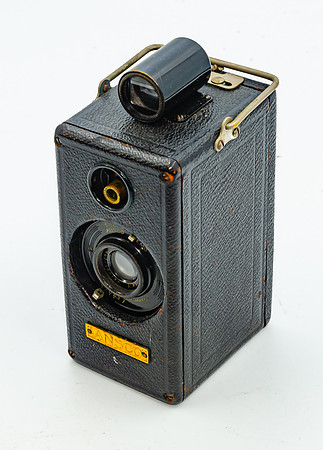
Ansco Memo Camera (c.1927): History, Making & Significance
⭐ Summary
The Ansco Memo, introduced in 1927, is widely regarded as America’s first 35mm still camera produced in significant quantity. It predates Kodak’s 135 cartridge by seven years and used Ansco’s own proprietary 35mm cassette system. Compact, fast‑shooting, and cleverly engineered, it became a landmark in early American miniature‑camera design.
🕰️ 1. Historical Background (1924–1927)
📌 Origins
• The Memo was developed around 1924 and introduced commercially in January 1927.
• It was the first camera to carry the “Memo” name, later reused on many unrelated Agfa‑Ansco models.
• Built in Binghamton, New York, by Ansco—one of Kodak’s major American competitors.
📌 Context in 35mm History
• The Leica A (Germany) debuted in 1925 using full‑frame 24×36mm.
• The Ansco Memo (USA) followed in 1927 using half‑frame 18×24mm, the same frame size as cinema film.
• At the time, no standardized 35mm still‑camera cartridge existed, so Ansco engineered its own cassette system.
🛠️ 2. Construction & Technical Design
🧱 Body & Materials
• Early models: varnished wood with brass fittings.
• Later models: leather‑covered wood, sometimes with shutter‑release guards.
• A special Boy Scout edition existed in olive drab with Scout insignia.
🎞️ Film System
One of the Memo’s most innovative features:
• Used proprietary Ansco Memo cartridges—rectangular metal (earlier wood) cassettes.
• Two cartridges loaded at once:
• Top: pre‑loaded film
• Bottom: empty take‑up cassette
• Film advanced vertically, like a movie camera.
• A spring‑action claw pulled the film down via perforations—no sprocket wheel.
This vertical transport allowed the Memo’s tall, slim form factor.
📐 Format
• 18×24 mm half‑frame images on double‑perforated 35mm cine film.
• Each cartridge yielded 50 exposures—a major selling point.
🔍 Lens & Shutter Options
Multiple configurations existed:
• Lenses from Wollensak, Bausch & Lomb, Ilex, Agfa.
• Common lenses:
• Ilex‑Ansco Cinemat 40mm f/6.3
• Wollensak Velostigmat f/6.3
• High‑end versions: Bausch & Lomb f/3.5 focusing lenses
• Shutters: Ilex or Betax, with speeds T, B, 1/25–1/100, and some up to 1/500.
🔭 Viewfinder & Ergonomics
• Large, bright tubular optical finder on top—surprisingly good for the era.
• Foldable wire handle.
• Manual frame counter (brass disc) numbered to 50.
🧭 3. How It Was Made
🏭 Manufacturing Approach
• Built in Ansco’s Binghamton factory using:
• Wood bodies (machined and varnished or leather‑covered)
• Brass fittings
• Precision‑machined shutter assemblies
• Designed for mass production, unlike earlier American 35mm prototypes which were made in small numbers.
📦 Market Position
• Priced $20–$40 USD depending on lens/shutter—affordable for serious amateurs.
• Marketed as a compact, rapid‑shooting travel and “memo” camera—a way to record many small images cheaply.
🌍 4. Significance in Photographic History
🎯 1. First American 35mm Still Camera Sold in Quantity
Earlier U.S. 35mm cameras existed but were extremely rare.
The Memo was the first to achieve real commercial success.
🎯 2. A Bridge Between Movie Cameras and Still Cameras
• Used cine film
• Vertical transport
• Claw‑advance mechanism
• Half‑frame format
It was essentially a still‑camera adaptation of movie‑camera mechanics.
🎯 3. Pre‑Standardization Innovation
The Memo predates:
• Kodak’s 135 cartridge (1934)
• Most standardized 35mm still‑camera systems
Its proprietary cassette system shows how early manufacturers experimented before the industry converged.
🎯 4. Cultural Impact
• Compact, discreet, and capable of 50 shots, it was reportedly used by private detectives and travellers.
• Yet contemporary analysis notes it was intended for casual photography, not surveillance.
🎯 5. Collectability
Collectors prize the Memo for:
• Its role in early 35mm history
• Its quirky mechanics
• Its wood‑body construction
• Numerous variants (Boy Scout, leather‑covered, focusing versions)
📚 Summary
The Ansco Memo (c.1927) is a landmark in American photographic history: the first U.S. 35mm still camera to be produced in significant numbers, a clever hybrid of cine‑film engineering and compact still‑camera design, and a precursor to the standardized 35mm systems that would dominate photography for the next century. Its proprietary film system, vertical transport, half‑frame format, and wide range of lens/shutter options make it one of the most distinctive and innovative cameras of the 1920s.