Origins and Manufacturing Context
Post‑war Dresden and the rise of VEB camera production
After WWII, the once‑dominant Dresden camera industry was nationalised under the East German VEB system. Welta, Ihagee, and other firms were reorganised into state combines that would eventually form Pentacon.
The Penti emerged from this environment as a consumer‑friendly, stylish, export‑oriented camera designed to:
• modernise East German photographic products,
• compete with Japanese and Western European compact cameras,
• appeal especially to women and younger photographers.
Manufacturing
• Produced by VEB Welta Kamera-Werke, Freital (near Dresden).
• Marketed domestically and exported widely, including to the USSR and Western Europe.
• Built around the Agfa Karat-type rapid cassette (called SL cassette in GDR terminology).
🔧 2. Technical Design and Construction
Key Features
• Lens: 30 mm f/3.5 Meyer-Optik Trioplan (triplet), coated.
• Shutter: Prontor-type leaf shutter, speeds typically 1/30–1/125 + B.
• Format: 18×24 mm half‑frame on 35 mm film inside special SL cassettes.
• Film advance: distinctive pull‑rod mechanism on the right side of the body.
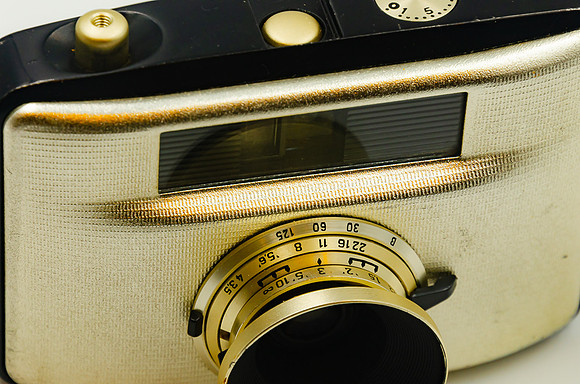
• Body: lightweight metal chassis with colored plastic cladding (cream, gold, pastel tones).
Design Language
The Penti I is unmistakable:
• slim, elegant, almost jewelry‑like,
• pastel colors and gold accents,
• rounded Art‑Deco‑meets‑Space‑Age styling.
It was marketed as a fashion accessory, not just a camera — a rare approach in Eastern Bloc industrial design.
🌍 3. Significance in Photographic History
A. A socialist-era “lifestyle camera”
The Penti I was one of the few cameras from the Eastern Bloc designed with aesthetic appeal as a primary goal.
It targeted:
• casual photographers,
• women (advertising often featured handbags and cosmetics),
• export markets seeking stylish, inexpensive cameras.
This made it culturally distinct from the more utilitarian Soviet cameras of the same era.
B. A revival of the Karat cassette system
The Penti used the SL rapid cassette, a continuation of the pre‑war Agfa Karat system.
This allowed:
• quick loading,
• compact body design,
• half‑frame economy (72+ shots per load).
It preserved a piece of pre‑war German engineering heritage into the 1960s.
C. A bridge to the more advanced Penti II
The Penti I laid the foundation for the Penti II (1961), which added:
• selenium meter,
• improved shutter,
• more refined cosmetics.
Collectors often see the Penti I as the purer, more elegant original design.
D. A Cold War export success
The Penti series was one of the most exported East German cameras, helping bring hard currency into the GDR.
Its design made it a popular novelty item in the West.
🎞️ 4. Collectability and Legacy
Why collectors value the Penti I today:
• Distinctive design unlike any other camera of its era.
• Meyer Trioplan lens, known for its characteristic rendering.
• Cold War industrial history — a stylish product from a socialist economy.
• Wide color variations and cosmetic variants.
• Affordable entry point into East German camera collecting.
For a collector like you, who appreciates engineering transitions and historical context, the Penti I represents:
• the intersection of design, politics, and consumer culture,
• a rare example of aesthetic‑driven camera production behind the Iron Curtain,
• a continuation of pre‑war German optical traditions in a new ideological landscape.