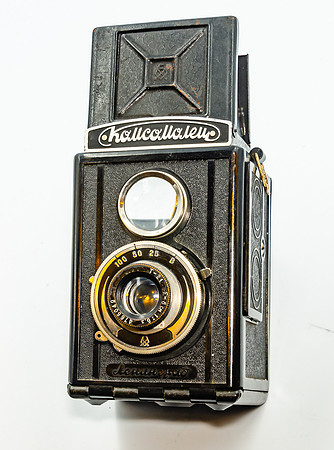
Комсомолец (c.1946): concise takeaway
The Комсомолец, introduced in 1946 by GOMZ (Leningrad), was the first mass‑produced Soviet post‑war roll‑film camera and the direct ancestor of the famous Lubitel line. It marked the USSR’s transition from pre‑war plate cameras to affordable 120‑film TLR‑style cameras, making medium‑format photography accessible to ordinary citizens and youth photographers.
1. Manufacturing context (1946–1951)
Post‑war industrial restart
• Production began in September 1946, making it the first Soviet camera released after WWII.
• Built entirely from domestic components, unlike many pre‑war Soviet cameras that relied on German parts or designs.
• Manufactured at GOMZ, the same factory that later became LOMO.
Production volume
• Total output: ~306,743 units (across all variants).
• Early 1946 production was extremely small (~3,500 units), making first‑series examples rare.
2. Design and technical characteristics (c.1946 version)
The 1946 Комсомолец is a pseudo‑TLR:
• Upper lens: viewing only (no focusing linkage).
• Lower lens: taking lens.
Optics
• Triplet‑21 (T‑21) 80 mm f/6.3 taking lens — a simple 3‑element design typical of early Soviet optics.
• Viewing lens: achromat, f/4.5 or f/2.8 depending on early batch.
Shutter
• Early shutter speeds: 1/25, 1/50, 1/100 + B.
• Leaf shutter, simple and reliable.
Film format
• 6×6 cm on 120 film.
• Early 1946 units had a left‑side red window for 6×9 markings, because Soviet 120 film still used 6×9 frame numbers.
Body
• Molded Bakelite/plastic body — a major innovation for Soviet cameras at the time.
• Waist‑level finder with ground‑glass screen.
3. Historical significance
A. First Soviet post‑war consumer camera
The Комсомолец symbolized the revival of Soviet civilian manufacturing after the devastation of WWII.
• It was the first camera available to the public after the war.
• It helped re‑establish GOMZ as the USSR’s primary optical producer.
B. Foundation of the Lubitel dynasty
The Комсомолец directly inspired the Lubitel (1949) and later Lubitel‑2, Lubitel‑166, etc.
• The body design was reused almost unchanged for the Lubitel.
• It established the Soviet tradition of simple, inexpensive TLR‑style cameras for amateurs.
C. Democratization of medium‑format photography
Before 1946, Soviet photographers mostly used:
• Plate cameras (Fotokor‑1)
• Folding cameras
• Limited pre‑war 35 mm models
The Комсомолец introduced:
• Easy film loading
• Simple waist‑level composition
• Affordable medium‑format quality
This made it ideal for youth clubs, schools, and amateur circles, aligning with its name:
“Комсомолец” = member of the Komsomol youth organization.
D. Transitional engineering milestone
It stands between:
• Pre‑war German‑inspired designs (Voigtländer Brillant)
• Post‑war Soviet consumer cameras (Lubitel, Smena, early Zorki)
It represents the moment when the USSR began independent, large‑scale roll‑film camera production.
4. Collector significance today
For a collector with your focus on Soviet engineering evolution, the Комсомолец is important because:
• It is the first post‑war Soviet camera.
• Early 1946 versions with frame counter + left red window are rare and highly collectible.
• It is the prototype of the Lubitel line, making it a foundational piece in Soviet TLR history.
• Numerous small variations (shutters, lens engravings, body mold differences) make it a rich field for typology