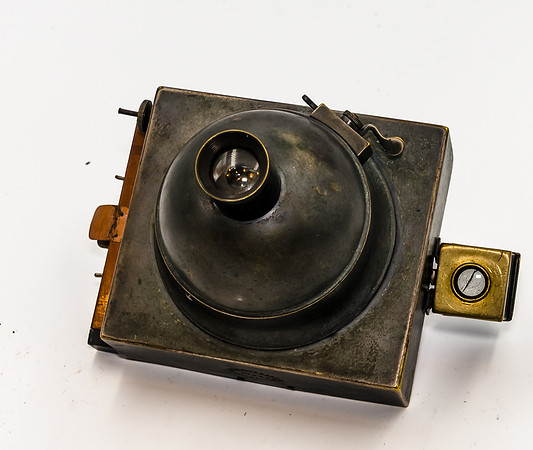
Photosphère Camera (Patented 1888): A Revolutionary Metal Camera
The Photosphère was one of the most distinctive cameras of its era — a compact, metal, weather‑resistant camera designed for tropical exploration.
It was patented by Napoléon Conti in 1888 and produced by the Compagnie Française de Photographie in Paris.
🪙 1. Purpose & Innovation
• Designed specifically for tropical climates, where wood warped and leather bellows deteriorated.
• One of the first fully metal cameras (brass body with silver plating).
• Compact, rugged, and easy to use — ideal for explorers and amateurs.
🧱 2. Construction & Materials
• Brass body, silver‑plated; unusually durable for the 1880s.
• Hemispherical front housing the shutter mechanism.
• Wooden or metal plate holders depending on model.
⚙️ 3. Unique Hemispherical Shutter
• A hemispherical guillotine shutter sits behind the lens.
• A spring‑tension mechanism controls shutter speed.
• This gave the camera its distinctive rounded front.
📐 4. Formats & Variants
About 4,000 units were produced across several formats.
Photosphère No. 1
• 8×9 cm dry plates
• Lenses: Cie. Française Aplanétique 92mm or Zeiss Anastigmat 92mm
Photosphère No. 2
• 9×12 cm plates
• Could accept a special back for early Eastman roll film
Photosphère No. 3
• 13×18 cm
• Two internal Watson viewfinders (horizontal & vertical)
Photosphère No. 4 (Stereo)
• 9×18 cm stereo plates
• Dual lenses and dual hemispherical shutters
🧭 5. Usability & Accessories
• Removable Watson viewfinder.
• Optional 12‑plate metal magazine or double dark slides.
• Some models had bicycle mounting lugs — extremely unusual for the era.
🕰️ 6. Historical Context
• Patented in 1888, the same year as George Eastman launched the Kodak roll‑film camera.
• Sold from 1889 to ~1902.
• Represented a transitional moment between plate cameras and the coming roll‑film revolution.