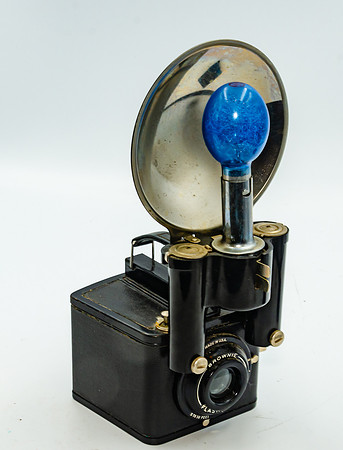
Origins and Manufacturing Context (Late 1930s–Early 1940s)
By 1940, Kodak had already dominated the amateur market with Brownies for four decades. But the rise of indoor photography, flashbulbs, and family event documentation created demand for a camera that could:
• synchronize with flashbulbs
• remain inexpensive
• be rugged and easy for non‑photographers
The Six‑20 Flash Brownie (its original name in 1940) was Kodak’s answer. It was built in the USA and sold for $4.25, making flash photography accessible to the average household.
🛠️ Construction and Technical Features
1. Sheet‑Metal Body with Leatherette Covering
A step up from earlier cardboard Brownies, the Flash Six‑20 used a metal body for durability—important during wartime manufacturing constraints.
2. Flash Synchronization (Its Defining Feature)
• Designed to mount a large bulb flashgun, powered by two 1.5‑volt batteries.
• Compatible with No. 10 or No. 40 flashbulbs.
This made it one of the earliest Brownies optimized for indoor and night photography.
3. Simple but Effective Optics
• Single meniscus lens
• Two‑position focusing:
• 5–10 ft
• 10 ft to infinity
4. Shutter
• Rotary shutter
• Two modes: Instantaneous and Bulb (Time)
5. Film Format
• Used 620 roll film
• Produced 2¼ × 3¼ inch (6×9 cm) negatives—large enough for contact prints without enlarging
🎞️ Design Evolution and Naming
The camera was originally released as the Six‑20 Flash Brownie in 1940.
In 1946, Kodak renamed it Brownie Flash Six‑20, with only minor cosmetic changes.
Your c.1940 example is therefore from the first production period (1940–1946)—the wartime variant.
🌍 Historical Significance
1. Democratizing Flash Photography
Before the Flash Six‑20, indoor photography required expensive equipment or magnesium flash powder. This camera brought safe, simple flashbulb photography to millions of households.
2. Wartime‑Era Production
Produced from 1938/40 to 1942 (depending on source), the early Flash Six‑20 models reflect Kodak’s wartime manufacturing strategy:
• metal construction
• simplified mechanics
• emphasis on reliability
3. A Bridge Between Box Cameras and Modern Consumer Cameras
The Flash Six‑20 introduced features that would become standard:
• flash synchronization
• built‑in portrait lens
• tripod socket
• multiple‑exposure guard
It represents the moment when the Brownie line matured from “simple snapshot boxes” into versatile family cameras.
4. Cultural Impact
This camera documented:
• wartime family life
• 1940s–50s domestic photography
• early baby photos, weddings, birthdays, and holidays across the US and Commonwealth
Its large negatives preserved detail exceptionally well, making it a favourite for family albums.
📈 Collector Significance
For a collector like you—focused on engineering transitions and historical context—the Brownie Flash Six‑20 matters because:
• Early (1940–42) units are scarcer than the post‑1946 renamed version.
• It marks Kodak’s first mainstream flash‑synchronized Brownie.
• The trapezoidal metal body and flashgun mount make it visually distinctive.
• It represents a wartime design philosophy: rugged, simple, functional.
• Prices remain modest, but early examples with flashgun and box are increasingly collectible.