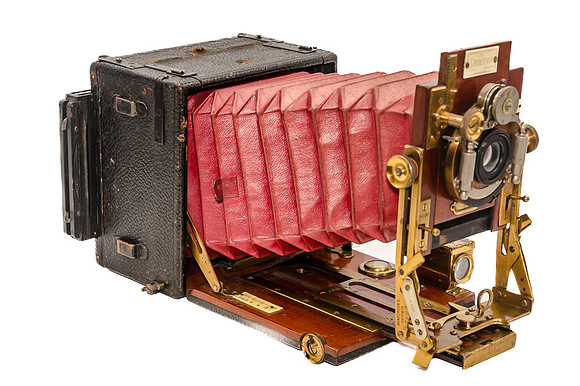
The Sanderson Model L (c.1899) represents one of the most advanced British field/hand cameras of the late 19th century, built around F.H. Sanderson’s revolutionary 1895 “Universal Swing Front” design. It sits at a pivotal moment in camera evolution—when precision movements, architectural correction, and portability were becoming essential for serious photographers. Below is a clear, structured explanation of both the broader history and the specific significance of the Model L.
📷 The Sanderson Model L (c.1899)
The Model L is part of the Sanderson line sold by Houghton and manufactured by Holmes Brothers, based on Frederick Herbert Sanderson’s 1895 patent. His design solved a major problem for architectural photographers: how to keep the camera level while correcting verticals and composing precisely.
⭐ Key Innovations
1. Universal Swing Front (Sanderson’s 1895 Patent)
• Lens board held between slotted struts with a clamping bolt.
• When unclamped, the lens board can:
• rise
• fall
• tilt
• move forward/back
• Allows rapid rough focus → then precise final focus with one movement.
• Eliminates the need to tilt the entire camera body for architectural subjects.
• A 1897 Cambridge test widely publicized its superiority.
2. Exceptional Movement Range
• Ample rising front for tall buildings.
• Front tilt without disturbing camera level.
• Rear standard could be racked close for wide‑angle work.
• Double extension → effectively triple extension for long lenses.
3. Build & Materials
• Leather‑covered mahogany body (typical for Sandersons).
• Brass fittings.
• Red bellows common on late‑1890s examples (seen in surviving Model L units).
4. Manufacturer & Market Position
• Sold by Houghton, made by Holmes Brothers.
• Aimed at advanced amateurs and professionals—especially architectural photographers.
• Sanderson cameras later became part of Houghtons Ltd in 1904.
🧭 Historical Context & Significance
🔹 A Camera Designed by an Architectural Photographer
Frederick Herbert Sanderson (b. 1856) specialized in architectural subjects and found existing cameras inadequate. His design directly addressed:
• converging verticals
• limited front rise
• awkward tripod tilting
• slow focusing workflows
He created a camera that allowed level tripod + full front movements, a major advantage for architectural work.
🔹 A High‑Precision British Alternative
While American makers (e.g., Rochester Optical) focused on compact plate cameras, Sanderson emphasized:
• mechanical precision
• movement flexibility
• architectural correctness
This made Sanderson cameras highly respected in the UK and Commonwealth markets.
🔹 Transitional Moment in Camera Evolution
The Model L sits at the crossroads between:
• traditional wooden field cameras
• increasingly sophisticated movement‑rich technical cameras
• the rise of roll‑film hand cameras
It represents the peak of late‑Victorian plate‑camera engineering.
🧩 Where the Model L Fits in the Timeline
🎯 Why the Sanderson Model L Matters Today
• Historically important: A landmark in movement‑rich field camera design.
• Architectural photography milestone: One of the first cameras optimized specifically for this purpose.
• Collectible: Attractive mahogany/brass construction, red bellows, and distinctive Sanderson mechanics.
• Technically fascinating: The Universal Swing Front remains one of the most elegant mechanical solutions of its era.