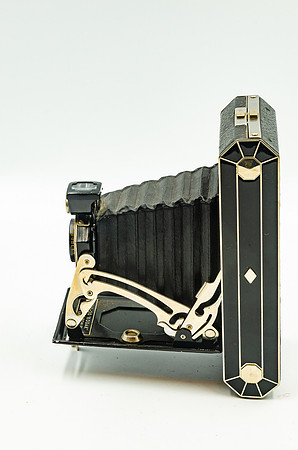
Kodak Six‑20 (c.1933): History, Construction, and Significance
🛠️ 1. Origins and Manufacturing Context (1932–1933)
Kodak introduced the Six‑20 format in 1932, and by 1933 the Six‑20 line had split into two major families:
A. Six‑20 Brownie (Box Camera)
• Introduced: March 1933
• Manufactured in: United States and United Kingdom
• Construction:
• Leatherette‑covered metal body
• Distinctive Art Deco metal fascia (different US vs UK designs)
• Two brilliant finders
• Lens & Shutter:
• Diway lens with built‑in close‑up lens (US model)
• Rotary shutter with instantaneous & time modes
• Film: 620 roll film, producing 8 exposures of 6×9 cm
• Price: US$2.50, making it extremely accessible
B. Six‑20 Kodak (Folding Camera)
• Introduced: 1932, redesigned in 1933 as the Six‑20 Model C
• Construction:
• Self‑erecting folding bed
• Angled ends, pig‑grained leatherette
• Swivelling brilliant finder
• Octagonal shutter plate with chrome & enamel accents
• Lens & Shutter Options:
• Doublet lens with Kodon shutter
• Kodak Anastigmat f/6.3 with Kodon shutter
🔍 2. Key Design Features
Six‑20 Brownie (Box)
• Two focusing zones: 5–10 ft and 10 ft to infinity
• Aperture slider (US model)
• UK model offered three distances (Groups / Landscapes / Portraits) using supplementary lenses
• UK model also offered three apertures: f/11, f/16, f/22
• Art Deco “Kodak Girl” striped fascia on UK versions
Six‑20 Kodak (Folding)
• Self‑erecting mechanism—faster to deploy than earlier folders
• More refined aesthetics than Brownie models
• Higher‑quality lens options (Anastigmat)
🌍 3. Historical Significance
A. Democratization of Photography
The Six‑20 Brownie continued Kodak’s mission of “You press the button, we do the rest”, offering:
• Extremely low cost
• Simple operation
• Durable construction
This made snapshot photography accessible to millions during the Depression era.
B. Introduction of the 620 Film Standard
The Six‑20 line helped establish 620 film, a slimmer‑spool variant of 120 film.
• Allowed more compact camera bodies
• Became a Kodak standard for decades
C. Art Deco Industrial Design
Both the Brownie and the folding Six‑20 models embraced Art Deco geometry, reflecting 1930s consumer aesthetics.
• The Brownie’s metal fascia is now iconic
• The folding Six‑20’s octagonal shutter plate and chrome accents are highly collectible
D. A Bridge Between Eras
The Six‑20 family sits at a crossroads:
• Between box cameras and more advanced folding cameras
• Between Victorian roll‑film traditions and modern compact cameras
• Between amateur snapshot culture and more serious portable photography
🏛️ 4. Collector Importance Today
For collectors—especially someone with your deep interest in early 20th‑century engineering—the Six‑20 line is significant because:
✔️ Abundant but historically rich
Common enough to find, but with meaningful variations (US vs UK, Brownie vs folding).
✔️ Art Deco appeal
Highly desirable for display collections.
✔️ Film format relevance
Represents Kodak’s strategic shift to proprietary formats.
✔️ Technological transition
Shows the evolution from simple box cameras to more sophisticated folding designs.
📌 Summary
The Kodak Six‑20 cameras of 1933—both the Brownie box and the folding Model C—embody Kodak’s push toward stylish, affordable, and user‑friendly photography. Their Art Deco design, adoption of 620 film, and mass‑market success make them historically important and highly collectible today.