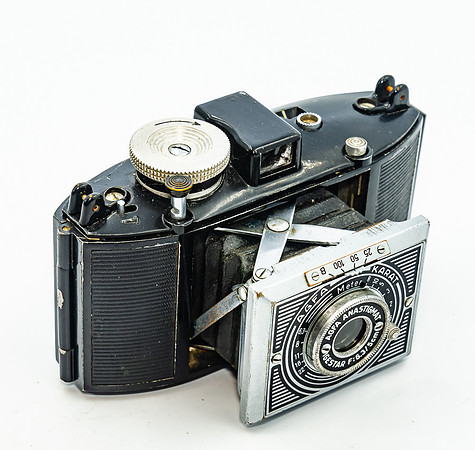
Agfa Karat 6.3 Art Deco (c.1936)
History, Construction, and Significance
🏭 1. Origins & Manufacturing Context
• Introduced in 1936, the Karat 6.3 was the first model in what would become a long-running Agfa Karat line.
• Designed in Germany during a period of rapid miniaturization and modernization of 35 mm photography.
• Agfa had merged with Ansco in 1928, and the Karat’s film system was derived from the Ansco Memo cassette (1927).
• The camera was released just before WWII, representing Agfa’s push to compete with Kodak and Zeiss Ikon in the compact‑camera market.
🧩 2. Technical Design & Construction
Art Deco Industrial Design
• The Karat 6.3 Art Deco features a rounded cast‑aluminum body, covered in durable black synthetic material.
• Its collapsible front plate is supported by four scissor struts and decorated with a geometric Art Deco insert—a hallmark of 1930s industrial styling.
• The top plate includes:
• Galilean tube viewfinder
• Internal frame counter window
• Film advance knob with double‑exposure interlock
• Shutter release and time‑exposure lock
Optics & Shutter
• Lens: Agfa Igestar 50 mm f/6.3, a three‑element front‑cell focusing design.
• Aperture: f/6.3–22
• Shutter: Agfa Automat leaf shutter with speeds B, 1/25, 1/50, 1/100.
• Flash: None (typical for mid‑1930s compact cameras).
🎞 3. The Karat/Rapid Film System
One of the camera’s most important innovations was its proprietary 35 mm cassette system, later revived as Agfa’s Rapid system.
How it worked
• The camera used two identical cassettes:
• One preloaded with film
• One empty
• Film was pulled from one cassette and pushed into the other, eliminating the need to rewind.
• The system produced 12 exposures (24×26 mm).
Why it mattered
• Ensured the film was always held perfectly flat in the focal plane.
• Reduced risk of accidental exposure when opening the camera.
• Represented an early attempt to simplify 35 mm handling for amateurs.
This system was later reintroduced in 1964 as the Agfa Rapid cartridge, nearly identical to the original Karat cassette.
⭐ 4. Significance in Photographic History
A. A Pioneer of Compact 35 mm Folding Cameras
The Karat 6.3 was among the earliest strut‑folding 35 mm cameras, predating many later compact designs. It blended portability with mechanical sophistication.
B. A Landmark of Art Deco Camera Design
Its sculpted, rounded body and geometric front plate make it one of the most visually distinctive cameras of the 1930s—a prized object for collectors of Art Deco industrial design.
C. Foundation of the Karat Line
The 6.3 Art Deco established the architecture for:
• Karat 4.5
• Karat 3.5
• Karat 12 / 2.8
• Karat 36 (first to use standard 35 mm cassettes, 1948)
D. Influence on Post‑war Rapid System
Its cassette design directly inspired the Agfa Rapid system of the 1960s, showing the long-term impact of the 1936 engineering.
🏆 5. Collector Perspective (Your Domain)
For a collector focused on early engineering and design evolution, the Karat 6.3 Art Deco stands out because:
• It represents Agfa’s first major 35 mm innovation before the war.
• Its Art Deco body is unique—no later Karat models retained this sculptural aesthetic.
• It marks the birth of the Karat/Rapid cassette lineage, a historically important but short-lived alternative to Kodak’s 135 system.
• Surviving examples with intact struts, clean Igestar lenses, and functioning shutters are increasingly scarce due to the fragile mechanics and pre‑war production numbers.